Driveway Pavers: Materials, Thickness & Planning

A paver driveway must do more than look attractive. It has to support parked vehicles, resist the forces created by turning and braking, and remain stable through changes in weather and soil moisture.
That's why choosing pavers for a driveway is different from choosing them for a patio. A paving unit that works perfectly for a garden walkway may not be suitable for repeated vehicle traffic.
A durable paver driveway depends on the complete pavement system: vehicle-rated pavers, a properly prepared subgrade, a suitable aggregate base, effective edge restraints, and controlled drainage. Choosing thicker or more expensive pavers cannot compensate for weak soil or inadequate construction beneath them.
This guide explains which driveway paver materials to consider, how vehicle loads affect thickness and base requirements, why laying patterns matter, and what to check before approving a contractor's proposal.
Are Pavers a Good Choice for a Driveway?
Yes. Interlocking concrete pavers, suitable clay paving brick, and properly specified natural stone units can all be used to construct driveways.
Unlike a continuous poured concrete slab, a segmental paver driveway consists of individual units working together through their joints, bedding, base, and edge restraints.
A correctly designed system can distribute vehicle loads while allowing individual units to be removed for certain repairs or underground utility work.
Pavers also offer considerable flexibility in color, texture, and layout.
However, a paver driveway has different construction and maintenance requirements from asphalt or poured concrete.
Joint material needs attention, edge restraints must remain secure, and the pavement structure must withstand the expected traffic.
Main advantages and limitations
| Advantages | Limitations |
|---|---|
| Wide selection of colors, patterns, and materials | Often higher initial cost than basic asphalt or concrete |
| Individual units can be replaced | Poor base construction can lead to settlement and rutting |
| Selected areas can be opened for utility access | Joints and edge restraints require maintenance |
| Suitable systems accommodate normal environmental changes | Wrong paver thickness or geometry can cause damage |
| Can be designed for residential and heavier vehicle traffic | Requires careful attention to drainage and subgrade conditions |
The decision should depend on the driveway's intended use, site conditions, appearance, and budget.
What Makes Driveway Pavers Different From Patio Pavers?
The most important difference is the loading.
A patio usually supports people, furniture, and other relatively light loads.
A driveway experiences concentrated tire loads, repeated parking, braking, acceleration, and turning.
These forces affect more than the paving units themselves.
Vertical loading
A vehicle transfers its weight through the tires to the surface beneath.
The pavers and supporting pavement layers must distribute that load without excessive deformation.
If the underlying soil or aggregate base cannot provide adequate support, the driveway may develop depressions even when the pavers remain intact.
Horizontal loading
Vehicles also create forces parallel to the pavement surface.
Braking, accelerating, and turning can push or rotate individual paving units.
This makes interlock, joint filling, laying pattern, and edge restraint especially important.
Repeated loading
A driveway may experience hundreds or thousands of vehicle movements over its service life.
The frequency and type of loading matter.
A driveway used only by passenger cars is different from one regularly supporting delivery trucks, large recreational vehicles, or commercial equipment.
A brief visit by a heavy vehicle is not necessarily equivalent to frequent heavy-vehicle use, but it still deserves consideration.
Before selecting pavers, determine which vehicles will actually use the driveway—not just which vehicles are parked there today.
How Thick Should Driveway Pavers Be?
Paver thickness is important, but there is no single minimum suitable for every driveway design.
For conventional interlocking concrete pavement, guidance from the Concrete Masonry and Hardscapes Association (CMHA) recognizes 2⅜-inch (60 mm) pavers for appropriate residential driveway applications.
For broader or heavier vehicular applications, 3⅛-inch (80 mm) pavers are commonly specified.
These dimensions describe the individual paving units, not the full pavement structure.
60 mm vs. 80 mm driveway pavers
| Paver Thickness | Typical Application Context | Important Qualification |
|---|---|---|
| 2⅜ in. (60 mm) | Suitable pedestrian and certain residential driveway applications | Exact unit shape, traffic, and support system must be appropriate |
| 3⅛ in. (80 mm) | More demanding vehicular applications and selected heavy-duty residential projects | Does not compensate for an inadequate base |
| Thicker vehicle-rated units | Specific heavy-duty applications | Requires a design appropriate to traffic and material properties |
The CMHA Construction of Interlocking Concrete Pavements technical bulletin describes 60 mm units for driveways and limited vehicular use, with 80 mm units typically used in streets and industrial applications.
Why paver shape matters
Thickness alone does not determine whether a paving unit is suitable for a driveway.
The relationship between its length and thickness affects resistance to rotation under traffic.
CMHA guidance includes limits on the length-to-thickness ratio for vehicular applications, with stricter guidance applying to more demanding loads.
Long, thin paving slabs may be attractive for patios but unsuitable for repeated tire loading unless specifically designed and approved for that use.
What about large-format pavers?
Large-format concrete slabs deserve special attention.
A manufacturer's pedestrian paving slab may not have the same load rating as a conventional interlocking concrete paver.
CMHA's 2025 guide specification for paving slabs on aggregate bases addresses limited residential vehicle use and identifies additional thickness considerations for these units.
Do not assume that every large concrete slab is driveway-rated because it looks substantial.
Before ordering, confirm the manufacturer's intended application, dimensions, thickness, and installation requirements for the exact product.
Best Paver Materials for Driveways
Concrete pavers are widely used for residential driveways, but clay brick and selected natural stone products are also options.
The best material depends on traffic, appearance, climate, maintenance, and installation requirements.
1. Concrete driveway pavers
Interlocking concrete pavers are manufactured paving units available in numerous shapes, surface textures, and colors.
Their regular dimensions can support consistent laying patterns and joint spacing.
Products intended for interlocking concrete pavement in the United States are commonly specified under ASTM C936/C936M.
Why choose them?
Concrete pavers offer a broad range of designs and are available in products specifically intended for driveway use.
They can be installed with effective interlocking patterns and replaced individually when necessary.
What should you check?
Verify the unit's actual suitability for vehicle traffic, thickness, dimensional characteristics, weathering resistance, and intended installation method.
Surface appearance alone does not establish structural performance.
Color variation, surface wear, staining, and efflorescence may also affect long-term appearance.
2. Clay brick driveway pavers
Clay paving brick is manufactured from fired clay or related materials.
It provides a distinct appearance and is available in products designed for pedestrian and vehicle applications.
However, ordinary building brick should not be assumed suitable for driveway paving.
ASTM C902 covers paving brick used in pedestrian and light-traffic applications, including low-volume residential driveways.
ASTM C1272 addresses paving brick intended for heavy vehicular traffic.
Why choose them?
Clay pavers offer a traditional appearance and material characteristics that differ from manufactured concrete.
What should you check?
Confirm that the exact brick meets the appropriate paving specification and is suitable for the expected traffic, climate, and installation method.
Brick dimensions, abrasion resistance, and product classification matter.
3. Natural stone driveway pavers
Granite, certain dense stone setts, and other suitable natural stone units can be used in driveway projects.
Natural stone offers material variation and architectural character.
However, not every stone sold for outdoor paving is appropriate for vehicle traffic.
Thin flagstone or decorative stone slabs may crack under concentrated wheel loads if they are not designed for that application.
Why choose it?
Natural stone may be appropriate where appearance, material characteristics, and a properly designed construction system justify the additional complexity.
What should you check?
The stone type, individual unit dimensions, flexural performance, bedding method, expected loads, and climate exposure all need consideration.
A supplier should provide relevant technical information for the actual product.
Driveway paver material comparison
| Material | Main Strength | What Requires Attention | Suitable Starting Point |
|---|---|---|---|
| Interlocking concrete pavers | Broad selection of vehicle-rated products and patterns | Thickness, shape, finish, joint performance | Most conventional residential projects |
| Clay paving brick | Distinctive fired-clay appearance | Correct paving specification and traffic rating | Traditional residential designs |
| Natural stone pavers | Natural appearance and material variation | Structural properties, dimensions, cost, installation method | Custom designs with suitable engineering |
No material is universally the most durable.
The product must be appropriate for the load and supported by a properly designed pavement structure.
What Goes Under a Paver Driveway?
The ground beneath the visible paving units is a major factor in long-term performance.
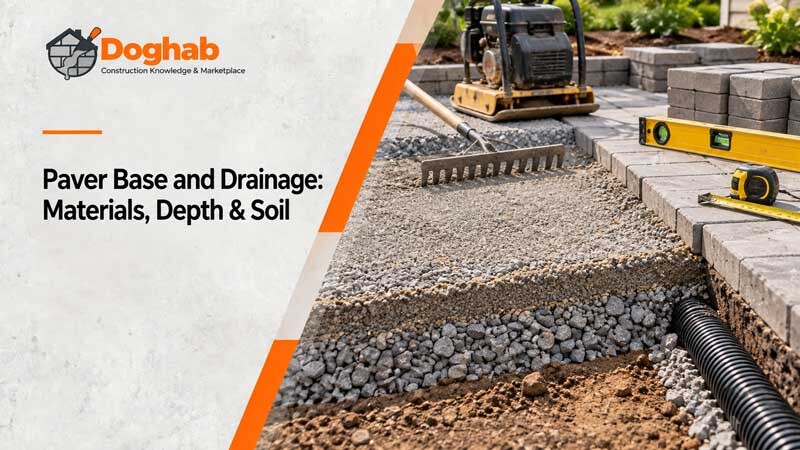
A conventional sand-set interlocking concrete paver driveway typically consists of several layers.
| Layer | Primary Function |
|---|---|
| Driveway-rated pavers | Provide the wearing surface and transfer loads |
| Joint sand | Helps the units interlock and transfer forces |
| Bedding sand | Provides a consistent setting layer |
| Compacted aggregate base | Distributes traffic loads and supports the pavers |
| Prepared subgrade | Supports the overall pavement structure |
| Additional separation or stabilization, where required | Addresses unsuitable soils or other project conditions |
The required structure may differ for permeable pavers, rigid-base installations, clay brick, or natural stone.
The subgrade supports everything above it
The subgrade is the natural soil or prepared material beneath the pavement base.
Its strength, moisture condition, and uniformity influence how well the driveway performs.
Weak or saturated soil may deform under repeated vehicle loads.
A thick paver cannot independently prevent settlement if the supporting ground is unstable.
Problematic soils may require additional excavation, stabilization, separation materials, or an engineered foundation design.
The aggregate base distributes loads
The compacted aggregate base provides a stable support layer beneath the bedding sand.
Its design must account for subgrade strength, drainage, frost exposure, and vehicle loading.
According to CMHA construction guidance, conventional residential driveways often use approximately 6–8 inches (150–200 mm) of compacted aggregate base under suitable conditions.
This is a planning reference, not a universal specification.
Weaker soils, poor drainage, freezing conditions, or heavier traffic can require a deeper or differently designed base.
The pavement should be built to the project requirements rather than an assumed minimum.
Why compaction matters
Aggregate is not sufficiently stabilized merely because it has been spread evenly.
Appropriate compaction reduces the risk of later movement and helps the pavement support vehicle loads.
Subgrade preparation and base compaction must follow the required material and project specifications.
The equipment, layer thickness, moisture condition, and testing requirements should suit the design.
A contractor should be able to explain how the base will be built and verified rather than simply promise that it will be compacted.
Bedding sand is not a substitute for the base
Bedding sand provides the setting layer for conventional sand-set interlocking pavers.
It is not intended to compensate for major irregularities in the aggregate base.
Using excessive bedding material to correct a poorly prepared base can create conditions for uneven settlement.
The bedding and joint materials should comply with the selected pavement system.
Why Edge Restraints Matter for Driveways
Edge restraints are sometimes treated as a finishing detail, but they have a structural role.
They help keep the paving units tightly contained so that vehicle forces do not cause the pavement to spread.
Without effective restraint, traffic can move the outer units and gradually compromise the interlocking surface.
The CMHA guide to edge restraints for interlocking concrete pavements explains their importance in maintaining pavement interlock under vehicle forces.
Common edge restraint arrangements
Depending on the design, a driveway may use concrete curbing, suitable precast units, approved metal or polymer restraints, or another structurally appropriate boundary.
The correct selection depends on traffic, base type, product specifications, and the forces the edge is expected to resist.
Decorative landscape edging should not automatically be used as a driveway restraint.
Driveway edges need special attention
Vehicle tires may travel close to driveway edges during parking or turning.
These locations can experience significant horizontal forces.
A restraint that performs adequately beside a pedestrian path may be unsuitable in a driveway without additional support.
The contractor should specify the restraint type, how it is anchored, and how it interacts with the base.
Which Paver Pattern Is Best for a Driveway?
The laying pattern affects both the appearance and the structural behavior of an interlocking paver surface.
For conventional rectangular concrete pavers exposed to vehicle traffic, CMHA recommends 45-degree or 90-degree herringbone patterns because of their interlocking performance.
Herringbone
A herringbone pattern places rectangular units in an alternating arrangement that breaks up long, continuous joints.
This helps the pavement resist movement caused by braking, accelerating, and turning.
It is a strong starting point when selecting a conventional driveway layout.
Running bond
Running bond uses staggered rows.
It can be attractive and may be suitable for selected driveway products and configurations.
However, it should not be assumed structurally equivalent to a herringbone pattern under every vehicle-loading condition.
The system designer or manufacturer should confirm suitability.
Decorative and mixed patterns
Borders, contrasting colors, and decorative layouts can be incorporated into a driveway.
The design must still maintain proper interlock and edge support in areas exposed to tires.
Small cut units near turning zones or driveway edges may be vulnerable.
CMHA guidance recommends that units exposed to tire traffic should not be cut smaller than one-third of a full paving unit.
The actual layout should account for vehicle paths, edge conditions, and the selected products.
A driveway pattern should be chosen for load performance first and appearance second.
Drainage: Where Should Driveway Water Go?
A paver driveway needs a planned drainage route.
Conventional interlocking pavers are not the same as permeable pavers.
Some rainwater can enter joints in a conventional installation, but the driveway should generally be designed to direct surface runoff to appropriate drainage locations.
It should not rely on uncontrolled infiltration through the joints.
Surface slope
The driveway must have suitable elevations and slope to prevent unwanted ponding and direct runoff away from vulnerable areas.
The precise grading depends on the driveway geometry, garage elevation, surrounding terrain, and local requirements.
The contractor should identify the intended drainage direction before construction.
Garage thresholds
A driveway sloping toward a garage can create a water-entry problem.
Depending on site elevations, the design may need a channel drain, appropriate grading changes, or another approved drainage arrangement.
The transition should also be comfortable and safe for vehicles.
Downspouts and nearby foundations
Roof runoff should not be discharged onto the driveway in a way that sends additional water toward the house.
Likewise, driveway reconstruction should not create a new drainage path toward basement walls, windows, or adjacent properties.
Driveways on sloping sites
Steep driveways present additional challenges.
Vehicle traction, runoff velocity, edge stability, and transitions to the road or garage all become more important.
A steep site may require a specially designed pavement and drainage system.
Surface texture should also be considered for wet and winter conditions.
Should you choose permeable driveway pavers instead?
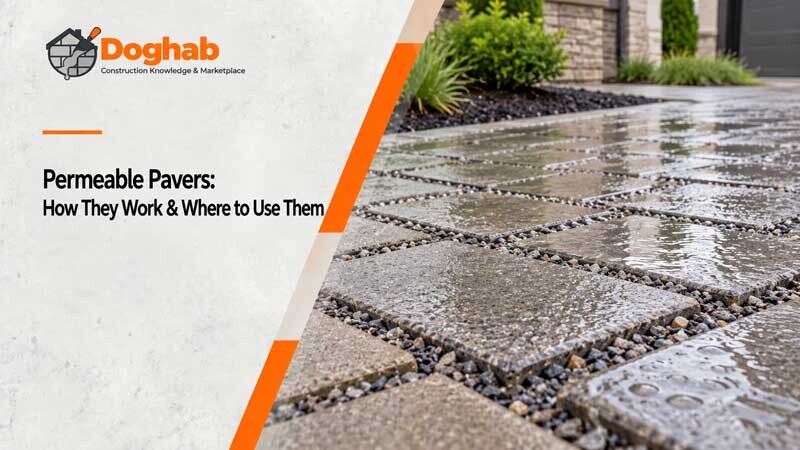
Permeable interlocking concrete pavement is a separate system designed to accept water through aggregate-filled joints and store or drain it beneath the surface.
It may be worth considering when stormwater management is part of the project objective.
However, permeable paving requires a different base, joint material, and drainage strategy from conventional sand-set interlocking pavers.
The systems should not be combined casually.
For conventional interlocking concrete pavers, the CMHA construction guide provides a useful reference for the standard aggregate-base and sand-setting approach.
How Soil and Climate Affect a Paver Driveway
A driveway design suitable for one property may not perform the same way on another.
Clay and weak soils
Clay-rich soils can retain moisture and may lose supporting capacity under certain wet conditions.
Some soils also change volume as moisture conditions vary.
These conditions can influence base thickness, drainage, and the need for separation or stabilization.
Freeze-thaw conditions
In cold climates, water within susceptible soils can contribute to frost heave.
The pavement design must consider drainage, frost susceptibility, and the supporting materials.
A segmental paver surface may tolerate certain environmental movements differently from a continuous rigid slab, but it is not immune to frost-related displacement.
Repeated heavy vehicle use
An occasional passenger-car driveway and a driveway used for a commercial van fleet do not have the same loading demands.
Vehicles such as loaded moving trucks, recreational vehicles, and larger service trucks can impose greater or differently distributed loads.
If these vehicles are expected to use the driveway regularly, the pavement structure should be designed accordingly.
Utility trenches and disturbed ground
A driveway may cross areas previously excavated for water, sewer, electrical, or other services.
Poorly compacted trench backfill can settle beneath the pavement.
These areas deserve attention during site assessment.
The contractor should identify known utility routes and evaluate disturbed ground before installing the new base.
Planning a New Paver Driveway
A successful driveway project begins with decisions about use, dimensions, materials, drainage, and existing ground conditions.
The following planning sequence helps homeowners organize those decisions without replacing the contractor's installation specifications.
Step 1: Define how the driveway will be used
List the types of vehicles expected to use the driveway.
Consider daily parking, turning movements, deliveries, and occasional heavy loads.
Also consider whether the driveway needs room for more than one vehicle or access to a garage.
Step 2: Measure the paved area
Measure the proposed width and length and identify curves, widened parking areas, or other irregular sections.
For a rectangular driveway, the surface area is calculated as:
Area (sq. ft.) = Length (ft.) × Width (ft.)
For example, a driveway measuring 20 feet by 25 feet has an area of 500 square feet.
The actual material order will also account for cutting, the selected pattern, edge details, and any wastage allowance specified by the supplier.
The paver quantity should be based on the manufacturer's coverage data for the exact unit, not a universal pieces-per-square-foot estimate.
Step 3: Review existing conditions
Check whether the project involves replacing an old driveway or constructing a new one.
Identify visible drainage problems, low areas, soft ground, settlement, and utility access points.
The contractor may need further site investigation before establishing the base design.
Step 4: Confirm local requirements
Driveway construction or changes to an existing driveway may require permits or approval from a local authority.
This can be especially important at the connection between private property and a public street.
Driveway aprons, sidewalks, curbs, drainage connections, and changes in access width may be regulated.
Verify the applicable requirements before finalizing the layout.
Step 5: Choose vehicle-rated pavers
Select the material, thickness, size, and finish according to the intended traffic and climate.
Request technical specifications for the actual product.
Do not substitute a visually similar pedestrian paver without confirming suitability.
Step 6: Finalize the base and drainage design
The contractor should establish the required excavation, subgrade preparation, base material, compacted thickness, bedding system, edge restraints, and drainage route.
These decisions should be settled before material delivery or excavation begins.
Step 7: Plan access and construction sequencing
Driveway replacement may temporarily block garage access or parking.
Discuss excavation, removal of the existing surface, material storage, construction access, and the expected period before vehicles can use the finished driveway.
The answer depends partly on the pavement system and any curing requirements associated with the selected joint materials or other components.
How Much Does a Paver Driveway Cost?
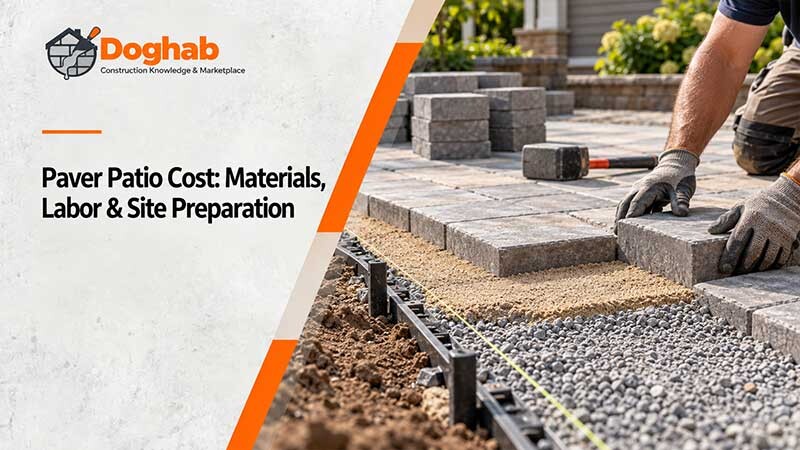
Paver driveway prices depend on area, material, site preparation, base requirements, labor, and design complexity.
As a broad U.S. planning reference, Angi's April 2026 paver driveway cost guide reports installed costs of approximately $10–$30 per square foot, with many projects falling between $6,000 and $18,000.
These figures describe a range of project types and locations. They are not a verified estimate for a particular driveway.
Site conditions can move actual prices outside the reported range.
What affects the project cost?
| Cost Component | What Can Increase the Price |
|---|---|
| Paving units | Premium materials, finishes, or specialized products |
| Excavation | Greater required depth or difficult equipment access |
| Demolition | Removing an existing concrete or asphalt driveway |
| Subgrade work | Weak soils, stabilization, or unsuitable fill |
| Aggregate base | Greater depth or specialized base requirements |
| Drainage | Channel drains, grading, or other water-management work |
| Edge restraints | More demanding traffic or perimeter conditions |
| Pattern | Complex designs and extensive cutting |
| Permits | Local approvals and inspections |
| Site restoration | Changes to landscaping, sidewalks, or adjacent surfaces |
Why price per square foot is not enough
Two contractors may quote the same paving area but propose different base depths, edge restraints, or drainage arrangements.
Those bids are not directly equivalent.
A contractor offering a lower price because the quote excludes necessary excavation or base work may not be offering better value.
Ask for the construction details before comparing the total price.
What Should a Paver Driveway Quote Include?
A useful proposal should identify the complete work, not simply state that new pavers will be installed.
| Item | What to Confirm |
|---|---|
| Paver product | Manufacturer, product name, thickness, finish, and intended vehicle use |
| Total area | Measured square footage and exclusions |
| Existing surface | Demolition, removal, disposal, and recycling responsibilities |
| Subgrade | Preparation and treatment of unsuitable conditions |
| Aggregate base | Material, compacted thickness, and compaction requirements |
| Bedding | Material type and specified construction method |
| Joint material | Material specification and installation requirements |
| Laying pattern | Layout and treatment of cuts and borders |
| Edge restraints | Material, location, and anchoring method |
| Drainage | Finished grades, inlets, outlets, and water flow |
| Permits | Responsibility for approvals and inspections |
| Restoration | Adjacent landscaping, sidewalks, and other disturbed areas |
| Completion | Inspection, cleanup, warranty, and maintenance instructions |
The estimate should also explain how unforeseen subsurface conditions will be handled.
For example, if excavation reveals unsuitable fill or a poorly compacted utility trench, the contractor should have a clear procedure for documenting, pricing, and approving additional work.
Comparing Two Driveway Paver Proposals
Suppose two contractors propose the same concrete pavers for the same driveway.
Contractor A specifies the finished pattern and product but provides no information about base thickness, compaction, or edge restraints.
Contractor B provides a defined base section, drainage grades, edge-restraint details, and a scope for removing the existing driveway.
Contractor B's price may be higher, but the proposals do not describe equivalent work.
Before deciding, ask Contractor A to specify the missing construction details.
The comparison should establish whether both proposals are capable of delivering the required pavement performance.
Questions worth asking
Ask the contractor to explain:
Why the proposed pavers are suitable for the expected vehicles.
How the soil conditions influence the base design.
How the aggregate base will be compacted and checked.
Why the selected laying pattern is suitable for vehicle traffic.
How the outer edges will resist tire forces.
Where runoff will go.
What happens if unsuitable soil is discovered.
Which work is excluded from the proposal.
For major drainage problems, steep sites, unstable soil, or substantial heavy-vehicle loading, additional design by a qualified professional may be necessary.
Common Paver Driveway Problems and How to Avoid Them
Most driveway problems cannot be diagnosed solely from their visible appearance, but certain warning signs point toward areas worth investigating.
Sunken areas and depressions
Depressions may result from inadequate subgrade support, base movement, poorly compacted backfill, or other factors.
Adding sand beneath the visible pavers does not necessarily repair a deeper support problem.
Ruts along tire paths
Repeated vehicle loads can reveal weaknesses in the pavement structure.
Ruts may indicate deformation in the base or subgrade rather than a problem with the strength of the paver units.
A separate guide, Why Paver Driveways Develop Ruts, should investigate this problem in greater depth.
Spreading or loose outer pavers
Movement near the driveway perimeter can be associated with failed or inadequate edge restraints.
Replacing displaced pavers without correcting the boundary support may not prevent recurrence.
Broken or chipped paving units
Individual units can crack or chip because of unsuitable products, excessive loading, inadequate support, impacts, or other conditions.
Repeated damage in the same area suggests that the supporting structure or loading conditions should be examined.
Persistent puddles
Standing water may indicate insufficient slope, localized settlement, blocked drainage, or another site problem.
Water repeatedly collecting beside the house deserves particular attention.
Joint sand loss
Joint material can be displaced by runoff, cleaning, vehicle traffic, or other conditions.
A suitable maintenance plan should include checking the joints and restoring material using the specified product.
How to Maintain a Paver Driveway
A properly designed paver driveway still needs routine care.
Maintenance helps preserve appearance and identify small changes before they become more extensive.
Clean the surface appropriately
Remove leaves, dirt, and other debris.
Use cleaning products and methods compatible with the paver material.
Aggressive pressure washing can displace joint material or damage some finishes.
Check joints and edges
Inspect for missing joint sand, loose units, and movement near driveway boundaries.
Any recurring movement should be investigated rather than repeatedly concealed.
Monitor drainage
After heavy rainfall, observe where water flows and whether new puddles appear.
Check accessible drains and discharge points for blockages.
Repair damaged areas promptly
For some paver repairs, individual units can be removed and replaced.
However, a repair must address the actual cause of distress.
If settlement originates beneath the base, replacing only the visible pavers may not provide a lasting correction.
Be careful with deicing and sealing products
Winter maintenance products and surface sealers should be compatible with the specific pavers and joint materials.
A sealer is not automatically necessary and does not substitute for a properly constructed base or drainage system.
Follow the manufacturer's care recommendations.
Frequently Asked Questions
Are pavers strong enough for a driveway?
Yes, when the units and complete pavement system are designed for the intended vehicles. Load capacity depends on the pavers, joint interlock, base, subgrade, edge restraints, and drainage.
What thickness of pavers should I use for a driveway?
Suitable 60 mm interlocking concrete pavers can be used for certain residential driveways. Heavier vehicular applications commonly use 80 mm or thicker units. The exact product and construction must match the anticipated loads.
Can I use patio pavers for a driveway?
Only if the particular pavers are approved for the expected vehicle loads and installed over an appropriate pavement structure. Some products intended for pedestrian areas are not suitable for driveways.
What is the best paver pattern for a driveway?
For conventional rectangular interlocking concrete pavers exposed to traffic, 45-degree and 90-degree herringbone patterns are commonly recommended because they provide effective interlock.
How deep should a paver driveway base be?
CMHA guidance describes approximately 6–8 inches of compacted aggregate base for many conventional driveway applications under suitable conditions. Weaker soil, frost exposure, drainage problems, and heavier loads can require a different design.
Are concrete or brick pavers better for driveways?
Both can work when the products are appropriately rated and installed. Concrete offers a wide range of standard interlocking options. Clay paving brick offers different material and appearance characteristics. The correct choice depends on the specific products, traffic, climate, and project requirements.
Can natural stone pavers support cars?
Some natural stone paving products are suitable for vehicle traffic, but many thin decorative slabs are not. Stone properties, dimensions, and the supporting pavement structure must be evaluated.
Do paver driveways need edge restraints?
Yes, an appropriate restraint system is important to maintaining interlock and resisting the lateral forces created by vehicles. The correct type and installation depend on the pavement design.
Will a paver driveway sink over time?
A properly designed and constructed driveway should limit excessive settlement, but no pavement is immune to unsuitable soil, drainage problems, poor compaction, or other changes. Visible sinking requires investigation of the underlying cause.
Can pavers be installed over an existing concrete driveway?
Some overlay systems are possible when the existing slab is structurally sound and the assembly is compatible. Drainage, finished elevations, garage clearance, and the slab's condition must be evaluated. An overlay should not conceal significant underlying deterioration.
Are permeable pavers suitable for driveways?
Yes, permeable interlocking concrete pavement can be designed for vehicle traffic. It requires a different drainage and aggregate-base system from conventional sand-set pavers.
How long does a paver driveway last?
Service life varies with loading, material quality, soil, base construction, climate, and maintenance. No universal lifespan can be guaranteed for every paver driveway.
Is sealing a paver driveway necessary?
Not always. Sealing may be appropriate for certain materials or appearance goals, but it is not universally required. Use only products compatible with the pavers and joint materials.
Are paver driveways suitable for snowplows?
They can be when properly designed, installed, and maintained. Surface evenness, edge conditions, appropriate snow-removal equipment, and manufacturer guidance matter. Raised or displaced units should be corrected before they are damaged by equipment.
Final Driveway Paver Planning Checklist
Before approving your driveway project, confirm that:
The expected vehicle types and frequency of use are known.
The selected paving units are appropriate for that traffic.
Paver thickness and shape have been evaluated together.
The subgrade and any previously disturbed areas have been assessed.
The aggregate base has a defined material and compacted thickness.
The bedding and joint materials match the selected system.
The laying pattern is appropriate for vehicle forces.
Suitable edge restraints are included.
Surface water has a reliable drainage route.
The design does not direct additional runoff toward the foundation.
Local driveway and access requirements have been checked.
The contractor's quote includes the full construction scope.
A plan exists for maintenance and future repairs.
Final Thoughts
A paver driveway is a pavement structure, not simply a decorative surface.
Concrete, clay, and suitable natural stone pavers can all be effective choices, but the visible material is only one part of the decision.
The more important questions are whether the driveway can support its expected vehicle loads, maintain interlock, resist settlement, and drain properly.
Choose vehicle-rated pavers, require a base designed for the site, pay attention to edge restraints and traffic patterns, and compare contractor quotes by construction scope rather than appearance alone.
Those decisions provide the strongest foundation for a stable, practical, and durable paver driveway.