Pavers vs. Concrete | Patio & Driveway Comparison

Pavers vs. Concrete: Comparing Patios and Driveways
Pavers and poured concrete can both create durable patios, walkways, and driveways.
The important difference is not simply how they look.
They are fundamentally different pavement systems.
A conventional concrete surface is cast in place as a slab and uses planned joints to manage shrinkage and movement. A conventional interlocking concrete paver surface is assembled from individual units placed over bedding and base layers. Joint sand, edge restraints, and the supporting layers all contribute to how the pavement performs.
Those differences affect:
initial cost;
cracking;
settlement;
repair;
drainage;
maintenance;
appearance;
construction sequence;
future access to underground utilities.
For many residential projects, the decision can be simplified this way:
Choose pavers when modular repairability, design flexibility, and the ability to lift and reinstall localized areas are especially valuable.
Choose poured concrete when you prefer a continuous surface, efficient large-area placement, and typically lower initial cost for a basic plain-concrete project.
Neither option is automatically more durable.
Base preparation, drainage, loads, climate, installation quality, and maintenance can matter more than the surface material alone.
Pavers vs. Concrete at a Glance
| Factor | Interlocking Pavers | Poured Concrete |
|---|---|---|
| Basic structure | Individual units over bedding and base | Cast-in-place slab |
| Initial cost | Often higher than basic plain concrete | Often lower for basic plain concrete |
| Appearance | Shapes, patterns, colors, borders | Continuous surface with several finish options |
| Cracking | Individual units avoid one continuous slab crack pattern | Shrinkage and movement are managed with joints, but random cracks can still occur |
| Settlement | Can develop depressions, rutting, lippage, or spreading | Can crack, settle, tilt, or fault |
| Local repair | Units can often be lifted and reinstated | Repair is possible but can remain visually noticeable |
| Underground access | Localized areas can often be opened and reinstated | Usually requires cutting or removing part of the slab |
| Construction sequence | Precast units do not need to gain strength after installation | Fresh concrete requires curing and strength development |
| Joint maintenance | Joint sand and edge conditions require monitoring | Joints and cracks require monitoring |
| Sealing | Optional and project-specific | Optional and project-specific |
| Drainage | Conventional systems still require intentional drainage | Requires intentional drainage |
| Permeability | Standard pavers are not automatically PICP | Standard concrete is not a permeable pavement |
| Driveway use | Suitable when designed for vehicle loading | Widely used when slab and support are appropriate |
| Typical advantage | Modularity and localized repair | Continuous surface and basic initial cost |
This comparison primarily concerns conventional interlocking concrete pavers over an aggregate base and conventional cast-in-place concrete.
Brick pavers, natural stone, porcelain pavers, permeable interlocking concrete pavement, pervious concrete, structural slabs, and specialty systems can behave differently.
The Fundamental Difference: Segmental vs. Continuous Pavement
The most important distinction is how each surface carries movement and how it is repaired.
How Interlocking Concrete Pavers Work
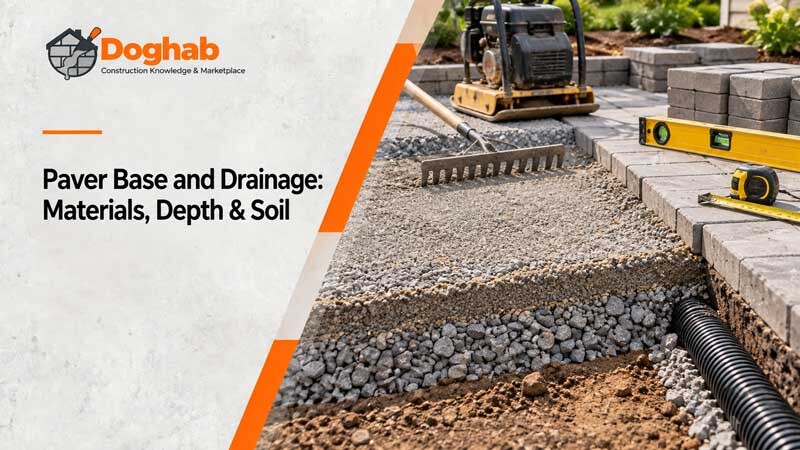
A typical conventional residential paver system can include:
prepared subgrade;
compacted aggregate base;
bedding sand;
concrete pavers;
joint sand;
edge restraints.
The units are not simply individual blocks resting independently on sand.
Joint sand contributes to interlock and shear transfer between units. Edge restraints prevent the pavement from spreading laterally. The bedding and base provide support and distribute loads to the underlying soil.
If the system is poorly designed or installed, problems can include:
depressions;
rutting;
widened joints;
rotating units;
lippage;
loss of joint sand;
edge movement.
The condition of the units themselves is only one part of paver performance.
How Poured Concrete Works
Cast-in-place concrete is placed while plastic and then hardens into a continuous slab.
Concrete changes dimension as it:
dries;
heats and cools;
responds to restraint;
carries loads.
These changes can create tensile stresses and cracking.
Contraction joints are formed, tooled, or sawed to create weakened planes that help regulate where cracks caused by dimensional change occur.
Joints reduce undesirable random cracking, but they do not create a guarantee of a crack-free slab.
Do Pavers Crack Less Than Concrete?
Pavers and concrete express distress differently.
Poured Concrete
A slab can develop:
drying-shrinkage cracks;
restrained-movement cracks;
settlement-related cracks;
temperature-related cracks;
load-related cracks.
Appropriate:
base preparation;
concrete mixture;
joint layout;
placement;
finishing;
curing;
can reduce unwanted cracking and help control its location.
Completely eliminating cracking from residential slab-on-ground concrete is not a realistic design assumption.
Interlocking Pavers
Because the pavement consists of separate units, it does not develop the same long continuous shrinkage cracks as a monolithic slab.
Individual pavers can still:
crack;
chip;
spall;
rotate;
settle;
become uneven.
The complete pavement can also develop:
rutting;
widened joints;
lateral movement;
edge failures.
So “pavers do not crack” is not a useful comparison.
A better distinction is:
Concrete commonly expresses movement through joints and cracks in a continuous slab. Paver systems accommodate movement between individual units but can develop alignment, settlement, joint, and edge problems when the supporting system moves.
Which Is More Forgiving of Localized Movement?
The segmental nature of pavers can make some localized movement easier to accommodate and repair.
If a small area settles, the units can move individually rather than forcing the same type of crack through a continuous slab.
That does not make pavers immune to poor soil or inadequate base construction.
Support problems can still produce:
depressions;
heaving;
lippage;
rutting;
widened joints;
lateral spreading.
Concrete can also be affected when underlying support moves, resulting in:
cracks;
settlement;
slab tilting;
faulting;
drainage problems.
For both pavement types, support beneath the visible surface is fundamental.
Neither system is a substitute for addressing serious soil, drainage, or base problems.
Repairability Is One of the Clearest Differences
Localized repair is one of the strongest practical advantages of interlocking pavers.
Repairing Pavers
When a localized area settles or individual units are damaged, a paver repair can often involve:
removing the affected pavers;
identifying the cause;
correcting bedding, base, or support where necessary;
reinstalling usable units;
replacing damaged units;
recompacting;
refilling the joints.
CMHA specifically documents disassembly and reinstatement of interlocking concrete pavement.
Existing pavers can often be reused.
This can make the finished repair much less conspicuous than many conventional pavement patches, although perfect color matching is not guaranteed.
Repairing Concrete
Concrete also has several repair options.
Depending on the condition, they can include:
crack repair;
joint repair;
surface patching;
slab lifting;
partial replacement;
complete panel replacement.
A practical difference is appearance.
New concrete can differ from old concrete in:
color;
texture;
aggregate exposure;
weathering.
A structurally successful repair may therefore remain visible.
The companion guide Repairing Pavers vs. Repairing Concrete will compare repair decisions in greater depth.
Underground Utility Access
Pavers can provide a useful advantage where future access beneath the pavement is likely.
A localized section can often be opened to reach:
utility lines;
irrigation;
drainage;
conduit.
After the underground work is complete, the base and bedding can be restored and the same units can often be reinstated.
CMHA describes this ability to remove and reinstate units as a significant characteristic of interlocking pavement.
With concrete, utility access normally involves:
saw cutting or breaking the slab;
excavation;
underground repair;
placement of replacement concrete.
The resulting patch can remain visible.
Which Costs More?
There is no universal price difference for every patio and driveway.
For basic residential patio and walkway planning, plain concrete often begins below interlocking pavers in current consumer cost comparisons.
A July 2026 Angi comparison reports broad installed planning ranges of approximately:
$4 to $15 per square foot for concrete
$6 to $30 per square foot for pavers
These figures are most useful as an early consumer comparison for patio and similar residential hardscape projects.
They should not be treated as driveway bids or universal national prices.
Driveway cost can change substantially with:
excavation;
vehicle loading;
pavement thickness or structural design;
base depth;
reinforcement where specified;
drainage;
access;
local materials;
demolition;
labor market.
Obtain project-specific local proposals for an actual patio or driveway. Use a concrete slab cost breakdown to check what the concrete proposal includes. For the paver option, use a paver patio cost breakdown to check that site preparation and installation are included.
Plain Concrete vs. Decorative Concrete
The lowest-cost concrete comparison normally assumes relatively straightforward plain concrete.
Cost can rise with:
stamping;
integral color;
stains;
exposed aggregate;
decorative borders;
complex finish work.
Once decorative concrete is introduced, the price difference between pavers and concrete can narrow or disappear.
The companion guide Pavers vs. Stamped Concrete will compare those decorative options directly.
Compare What Is Under the Surface
A paver quote and a concrete quote can contain very different preparation assumptions.
Before comparing totals, examine:
excavation;
grading;
soil preparation;
base material;
base thickness or pavement design;
compaction;
drainage;
edge restraints;
reinforcement where specified;
slab design;
jointing;
curing;
disposal.
The lower quote may simply include less work below the surface.
Which Is Faster to Install?
The answer depends on which part of the schedule matters.
Pavers
A paver project requires several construction steps:
excavation;
grading;
base installation;
compaction;
bedding;
laying units;
cutting;
edge restraint;
joint filling;
final compaction.
The paving units themselves are precast, so they do not need to gain concrete strength after they are installed.
Some ancillary materials or details may still have their own cure or waiting requirements.
Poured Concrete
Concrete can cover a large area efficiently during placement.
After placement, however, it needs:
appropriate curing;
protection;
time to develop sufficient strength before service.
Return-to-service timing depends on the project, concrete, weather, curing, and expected load.
Do not apply one universal waiting period to every new driveway or patio.
Appearance and Design
Both systems offer substantial design flexibility, but in different ways.
Pavers
Interlocking concrete pavers can offer:
multiple unit shapes;
laying patterns;
borders;
contrasting colors;
textures;
visual zoning.
Patterns are formed by the units themselves.
The modular surface can also be modified later, although replacement units may not perfectly match weathered existing pavers.
Concrete
Concrete provides a continuous visual surface.
Possible finishes include:
broom finish;
smooth or lightly textured finish;
exposed aggregate;
integral color;
stains;
decorative joints;
stamping.
Plain concrete can suit projects where a simple uninterrupted plane is preferred.
Which Looks Better?
That is a design decision rather than a technical one.
Pavers emphasize:
pattern;
individual units;
borders;
modularity.
Concrete emphasizes:
continuous surfaces;
finish;
color;
joint layout.
The architecture and landscape should guide the choice.
Paver Maintenance
Properly installed interlocking pavement generally has modest maintenance requirements, but it is not maintenance-free.
Routine attention can include:
removing debris;
cleaning;
monitoring joint-sand level;
correcting localized settlement;
checking edge restraints;
replacing damaged units.
CMHA recommends periodic preventive inspection and maintenance.
Joint Sand
Joint sand contributes to the performance of conventional interlocking pavement.
Sand can be lost through:
concentrated runoff;
wind;
aggressive cleaning;
traffic;
other site conditions.
When joint sand becomes too low, it should be replenished with material suitable for the system.
Aggressive pressure washing should be managed so it does not unnecessarily remove joint material.
Does a Paver Surface Need Sealer?
Not automatically.
CMHA treats both joint stabilization and sealing as optional measures used where their benefits are useful.
A sealer may help with:
stain resistance;
appearance;
easier cleaning;
some joint-sand stabilization.
A joint stabilizer may help reduce sand loss in demanding conditions such as:
concentrated water flow;
wind;
aggressive cleaning;
certain high-slope locations.
Neither product substitutes for correct pavement construction.
There is no universal rule requiring every residential paver patio or driveway to be sealed on a fixed schedule.
Concrete Maintenance
Concrete also needs observation and maintenance.
Potential conditions include:
cracking;
joint deterioration;
stains;
scaling;
spalling;
settlement;
drainage problems.
Some cracks remain stable and have little effect on service.
Others deserve attention because of:
displacement;
continued movement;
water entry;
deterioration.
Concrete sealing is also application-specific rather than universally mandatory.
Which Requires Less Maintenance?
There is no universal winner.
Pavers can require attention to:
joint sand;
individual-unit movement;
edges;
localized settlement.
Concrete can require attention to:
cracks;
joints;
surface deterioration;
patches.
A well-designed and well-built version of either system can require relatively modest routine maintenance.
Poor drainage or poor construction can make either pavement maintenance-intensive.
What About Weeds Between Pavers?
Weeds are not evidence that roots have necessarily grown upward through the entire paver base.
CMHA notes that weeds commonly develop when seeds become lodged in joints from above.
Joint maintenance and surface cleaning can reduce favorable conditions for growth.
If vegetation repeatedly becomes established, also examine:
joint condition;
accumulated organic debris;
drainage;
loss of joint material.
Are Conventional Pavers Permeable?
Conventional interlocking pavers should not be confused with a designed permeable pavement.
Standard sand-filled joints can allow some water entry.
That does not make the entire pavement a stormwater-management system.
A true permeable interlocking concrete pavement (PICP) typically includes:
openings or permeable joints;
permeable joint aggregate;
open-graded bedding;
open-graded base or subbase reservoir;
an infiltration, detention, or drainage strategy.
PICP is a separate pavement system.
Is Conventional Concrete Permeable?
Standard cast-in-place residential concrete is generally used as a surface that sheds water.
Pervious concrete exists, but it is a separate pavement system.
For this comparison, both conventional pavers and conventional concrete need intentional site drainage.
Drainage Matters for Both
Poor water management can cause problems beneath either pavement.
With pavers, persistent saturation or concentrated runoff can contribute to:
loss of joint or bedding material;
base problems;
subgrade problems;
settlement.
With concrete, poor drainage can contribute to:
saturated support;
erosion;
settlement;
freeze-thaw exposure;
joint deterioration.
Neither surface material compensates for a fundamentally poor drainage plan.
Patios: When Pavers Make Sense
Pavers can be especially attractive when you value:
patterns and borders;
modular design;
localized future repair;
utility access;
the ability to modify the paved area later.
They can also work well with irregular landscape geometry.
Patios: When Concrete Makes Sense
Plain concrete can be attractive when you value:
lower initial cost for a straightforward project;
a continuous surface;
a simple architectural appearance;
efficient placement across a larger regular area.
Decorative concrete can provide substantially more design variation.
Furniture and Surface Evenness
Both systems can provide stable patio surfaces when properly installed.
A paver surface should be built and maintained without excessive lippage or localized settlement.
A concrete surface can also become uneven if:
cracks displace;
slabs settle;
joints fault.
Neither material guarantees a perfectly unchanged surface over its entire service life.
Driveways Require More Than the Patio Comparison
A driveway introduces vehicle loads, turning forces, braking, and repeated wheel paths.
That makes design below the visible surface especially important.
Paver Driveways
Interlocking concrete pavers can be used for residential driveways when the pavement system is designed for vehicular traffic.
Important elements include:
suitable units;
appropriate base;
bedding material;
joint material;
edge restraint;
drainage;
compaction;
appropriate laying pattern and detailing.
Problems such as:
rutting;
settlement;
spreading;
edge movement;
usually need to be investigated as pavement-system problems rather than simply defective pavers.
Concrete Driveways
Concrete driveways similarly depend on more than the surface finish.
Relevant factors include:
soil and support;
base where appropriate;
slab design;
concrete specification;
placement;
joints;
finishing;
curing;
drainage.
A well-built driveway can still develop cracks.
Jointing is used to help regulate where some dimensional-change cracking occurs.
Heavy or Unusual Vehicle Loads
Do not use ordinary residential rules of thumb when regular traffic includes:
RVs;
commercial trucks;
heavy service vehicles;
equipment.
Paver pavement design may need different:
units;
base thickness;
structural layers.
Concrete design may need different:
slab thickness;
reinforcement;
concrete properties;
joints.
Expected loads should be disclosed before the pavement is designed.
Snow and Ice
Both pavement types can be used successfully in cold climates when the complete system is suitable for the exposure.
Snow Removal on Pavers
CMHA permits snow removal from interlocking concrete pavers with shovels, snow blowers, and plows.
Uneven or lifted units should be corrected because excessive lippage can allow a shovel or plow edge to catch the pavers.
Snow-removal procedures can also affect the appearance of the surface, as with other pavements.
Snow Removal on Concrete
Concrete provides a continuous surface, but:
displaced cracks;
faulted joints;
settlement;
can also interfere with snow-removal equipment.
Deicing Materials
Deicing chemicals can affect concrete-based pavement materials.
Performance depends on:
material quality;
saturation;
freeze-thaw exposure;
deicer chemistry;
application rate.
Follow product and pavement guidance rather than assuming one deicer is harmless to:
concrete;
concrete pavers;
natural stone;
sealers;
nearby materials.
Hot Weather and Surface Temperature
Both concrete and pavers can become hot in direct sunlight.
Surface temperature can be influenced by:
color;
solar exposure;
reflectance;
texture;
weather.
There is no useful universal rule that pavers are always cooler or hotter than poured concrete.
Accessibility and Trip Hazards
Either pavement can provide a suitable walking surface when properly designed and maintained.
Either can also develop displacement.
Pavers can develop:
lippage;
settlement;
loose or rotated units.
Concrete can develop:
displaced cracks;
joint faulting;
slab settlement;
spalling.
For projects subject to accessibility requirements, evaluate the actual surface and applicable standards rather than assuming either pavement type automatically complies.
Future Modifications
Pavers generally offer more flexibility when the owner later needs to:
extend the patio;
add drainage;
install conduit;
modify landscaping;
access a utility.
Localized areas can often be disassembled and reinstated.
With concrete, modifications commonly require cutting and new placement.
The paver advantage is repairability, not guaranteed visual matching.
Replacement units may differ from older units because of:
weathering;
production variation;
discontinued products.
Tree Roots, Soil Movement, and Localized Settlement
For localized support movement, pavers can often be easier to repair because the affected units can be removed before the underlying problem is corrected.
A concrete slab may require:
crack repair;
lifting;
partial replacement;
panel replacement.
With either material, the underlying cause should be addressed.
Possible causes include:
expansive soil;
roots;
erosion;
frost;
water;
inadequate compaction.
Resale Value
There is no credible universal resale premium that should drive this decision.
Value depends on:
local market expectations;
overall landscape quality;
installation quality;
maintenance;
design;
property condition.
A well-built simple concrete driveway can be more desirable than a poorly installed paver driveway, and vice versa.
How Long Do Pavers and Concrete Last?
Universal lifespan numbers are not especially useful for this comparison.
Service life depends on:
climate;
loading;
soil;
base;
drainage;
materials;
workmanship;
maintenance;
repair history.
Both systems can provide long service.
Both can fail prematurely when pavement design or construction is poor.
A more useful question is:
If this pavement develops a problem, what is likely to fail and how difficult will it be to correct?
Pavers Can Have a System Failure Without Broken Units
Individual pavers can remain intact while the pavement develops:
settlement;
rutting;
joint widening;
heaving;
edge movement.
That is why paver evaluation should include the layers and restraints below and around the units.
Concrete Can Remain Serviceable With a Crack
A visible crack does not automatically mean a concrete patio or driveway has failed.
A crack may remain:
narrow;
stable;
flush;
compatible with continued service.
Cracks involving continued movement, displacement, deterioration, or other warning signs deserve closer evaluation.
DIY Considerations
Neither system is effortless.
Pavers
A small paver project may allow a homeowner to work incrementally.
It still requires:
excavation;
grading;
base compaction;
bedding;
layout;
cutting;
edge restraints;
joint filling.
Poor work below the units can appear later as settlement.
Concrete
Small concrete projects may be manageable for an experienced DIYer.
Large slabs are less forgiving because:
placement is time-sensitive;
finishing has a limited working window;
joint planning matters;
weather matters;
curing begins immediately.
Project size and experience are more important than declaring either material universally DIY-friendly.
A Repairability Comparison
Utility Repair
Pavers: remove localized units, excavate, restore the pavement structure, reinstall suitable units.
Concrete: cut or remove part of the slab, excavate, then place a repair section.
Advantage: usually pavers.
Localized Settlement
Pavers: lift units, correct the supporting layers, reinstall.
Concrete: possible responses include lifting, partial replacement, or other repair depending on the cause.
Advantage in localized access: usually pavers.
One Damaged Surface Unit
Pavers: individual units can often be replaced.
Concrete: local patching is possible, but visual matching can be difficult.
Poorly Built Base
Neither system has an easy surface-only solution.
Substantial reconstruction may be required.
Patio Decision Table
| Pavers may fit better when... | Concrete may fit better when... |
|---|---|
| Localized repairability matters | Initial budget for a basic project matters |
| Patterns and borders are important | A continuous surface is preferred |
| Future underground access is likely | The area is large and relatively simple |
| Future modifications are expected | A plain concrete finish suits the design |
| Modular replacement is valuable | Fewer individual surface joints are preferred |
These are tendencies, not rules.
Driveway Decision Table
| Pavers may fit better when... | Concrete may fit better when... |
|---|---|
| Localized repair is a major priority | A basic continuous driveway is preferred |
| Pattern and border options matter | Initial project cost is a strong priority |
| Utility access may be needed | Large-area placement efficiency matters |
| Reinstatement is valuable | Individual-unit joint maintenance is undesirable |
| Joint and edge maintenance is acceptable | Visible slab cracking is an acceptable trade-off |
| A proper vehicular paver system can be built | A proper slab, joint, curing, and drainage system can be built |
For either driveway, the visible surface is only part of the pavement structure.
Questions to Ask a Paver Contractor
Ask:
Is this system intended for pedestrian or vehicle traffic?
What paver is specified?
What excavation is included?
What is known about the soil?
What base system is proposed?
How will it be compacted?
What bedding material is specified?
How will drainage work?
What edge restraint is included?
What joint material is specified?
How will drains and utility structures be detailed?
What repair approach is used if localized settlement occurs?
Is sealing or stabilization proposed, and what problem is it intended to solve?
What maintenance is expected?
What workmanship warranty is provided?
Questions to Ask a Concrete Contractor
Ask:
How will the subgrade be prepared?
What base is proposed, if any?
What slab design is planned?
What concrete specification will be ordered?
Where will contraction and isolation joints be located?
How and when will joints be created?
What finish is included?
What curing method will be used?
How will drainage be established?
How will adjoining structures be isolated where required?
How will cracks or movement be handled?
Is sealing proposed, and why?
When can pedestrian and vehicle traffic return?
What workmanship warranty is provided?
A useful contractor should be able to explain the complete pavement system rather than only the visible finish.
Pavers vs. Concrete Selection Checklist
Before choosing, confirm:
The project is defined as a patio, driveway, walkway, or another use.
Expected vehicle loads are known.
Soil and drainage conditions have been considered.
Paver and concrete quotes include comparable site preparation.
Drainage is defined for both options.
The paver proposal includes an appropriate base, bedding, joints, and edge restraint.
The concrete proposal includes appropriate slab design, joints, and curing.
Localized repairability has been considered.
Future utility access has been considered.
Maintenance expectations are understood.
Sealing is not being treated as automatically mandatory for either material.
Standard pavers are not being confused with PICP.
Decorative concrete is not being compared with plain concrete as though they cost the same.
Freeze-thaw exposure has been considered where relevant.
Snow-removal and deicing practices have been considered where relevant.
Quotes are based on comparable scope.
Future matching of replacement pavers is not being assumed.
Contractor experience matches the pavement system.
Applicable driveway, apron, drainage, permit, and local requirements have been checked.
Common Comparison Mistakes
“Pavers Never Crack”
Individual pavers can crack, chip, or spall.
Their main repair advantage is that localized units can often be replaced.
“Concrete Always Cracks Badly”
Cracking is part of concrete behavior, but joint design and construction strongly influence its location and significance.
“Pavers Cannot Settle”
They can.
Base, bedding, drainage, edge restraint, and compaction all matter.
“A Solid Concrete Slab Does Not Need a Good Base”
Support beneath the slab still affects long-term performance.
“All Pavers Are Permeable”
They are not.
PICP is a separate system designed for water infiltration, storage, and drainage.
“Pavers Always Cost More”
Basic pavers commonly cost more than basic plain concrete in consumer patio comparisons.
The comparison can change substantially with decorative concrete, premium pavers, excavation, base work, access, and local labor.
“Pavers Must Be Sealed”
They do not universally require sealing.
“Concrete Must Be Sealed”
Concrete sealing is also application-specific.
“Repairability Makes Base Construction Less Important”
Repairability does not justify poor initial construction.
Frequently Asked Questions
Are Pavers Better Than Concrete?
Neither is universally better.
Pavers generally provide greater localized repairability, modular design, and easier future access beneath the surface.
Plain concrete generally provides a continuous surface and can have a lower initial cost for a straightforward project.
Are Pavers More Expensive Than Concrete?
Often, when conventional interlocking pavers are compared with basic plain concrete in similar patio or walkway projects.
A July 2026 Angi consumer comparison reports about $6 to $30 per square foot for pavers and $4 to $15 per square foot for concrete.
Those figures should not be used as driveway pricing or as substitutes for local quotes.
Do Pavers Last Longer Than Concrete?
There is no useful universal lifespan winner.
Design, drainage, loads, installation, climate, maintenance, and repair history strongly affect both systems.
Do Pavers Crack?
Individual pavers can crack, chip, or spall.
The segmental pavement does not develop the same long continuous shrinkage-crack pattern as one cast-in-place slab.
Will a Concrete Patio Crack?
Concrete slabs can crack because of shrinkage, temperature change, restraint, loading, and support movement.
Contraction joints are used to help regulate where some dimensional-change cracking occurs.
Which Is Easier to Repair?
Interlocking pavers usually provide greater flexibility for localized repairs because units can be removed and reinstated.
Concrete is repairable, but patches and replacement sections can remain visually noticeable.
Are Pavers Better for Expansive Soil?
Do not treat pavers as a cure for expansive soil.
Their segmental construction can make some localized movement easier to repair, but significant soil movement still requires appropriate site and pavement design.
Are Pavers Better in Freeze-Thaw Climates?
Concrete pavers and poured concrete can both perform successfully in freezing climates when the complete pavement is designed and constructed for the exposure.
Climate alone does not establish a universal winner.
Are Pavers Permeable?
Standard interlocking pavers are not automatically a permeable pavement system.
PICP requires a specific open-jointed and open-graded pavement assembly.
Which Is Better for a Driveway?
Both can work well.
Pavers provide modular repairability and design options.
Concrete provides a continuous surface and often a lower initial cost for a basic installation.
For either system, support, drainage, and vehicle loading are critical.
Which Is Better for a Patio?
Pavers can be especially attractive when design flexibility and localized repair matter.
Plain concrete can be a strong choice where initial budget and a continuous surface are priorities.
Can Pavers Be Installed Over Concrete?
Specialized overlay systems exist, but placing conventional pavers over an existing slab should not be assumed to be appropriate automatically.
The existing slab, elevations, drainage, edge conditions, and selected system need to be evaluated.
Is Stamped Concrete Cheaper Than Pavers?
Pricing can overlap substantially.
Pattern, coloring, site preparation, paver selection, and local labor all affect the comparison.
The companion Pavers vs. Stamped Concrete guide will compare those options directly.
Which Is Easier to Snowplow?
Either can be maintained with snow-removal equipment.
With pavers, excessive lippage increases the risk of blades catching unit edges.
With concrete, displaced cracks and faulted joints can create similar obstacles.
Which Is Easier to Modify Later?
Pavers generally provide more flexibility for localized removal, utility access, extensions, and reinstatement.
Final Decision Guide
Start with the project rather than the surface sample.
Choose pavers when you value:
localized repair;
modular construction;
patterns and borders;
future underground access;
the ability to disassemble and reinstate sections.
Choose plain poured concrete when you value:
a continuous surface;
basic initial cost;
efficient coverage of a regular area;
a simpler visual appearance.
Then compare the conditions that can cause either pavement to perform poorly:
unstable soil;
inadequate support;
poor drainage;
inappropriate loads;
unsuitable materials;
poor installation.
The most useful distinction is not that one material is durable and the other is not.
Pavers and concrete manage movement differently, fail differently, and are repaired differently.
Understanding those differences is a better basis for choosing a patio or driveway than asking which material is universally best.
Technical References
Technical guidance on interlocking concrete pavement construction, maintenance, joint behavior, edge restraint, and reinstatement was reviewed against the Concrete Masonry & Hardscapes Association's Operation and Maintenance Guide for Interlocking Concrete Pavement.
Concrete jointing and crack-control principles were reviewed against the American Concrete Institute's current technical guidance on contraction joints.
The consumer cost snapshot used for early patio and walkway planning was checked against Angi's July 2026 Pavers vs. Concrete comparison.
Additional technical review included CMHA PAV-TEC-002, PAV-TEC-003, PAV-TEC-004, PAV-TEC-005, current CMHA PICP guidance, NRMCA CIP 6, current ACI slab guidance, and applicable ASTM product specifications.
Product requirements, pavement design, soil and drainage conditions, locally adopted requirements, manufacturer instructions, and project-specific engineering take precedence over general comparison guidance.
Technical review: October 8, 2026.