Concrete Curing: Methods, Timing & Weather Guide

Concrete does not become durable simply because the surface has hardened.
After placement, cementitious materials continue reacting with water. During this early period, the concrete needs suitable moisture and temperature conditions so hydration can continue and the material can develop the strength, surface hardness, density, and durability intended by the mixture and project.
That deliberate control is curing.
Curing may involve supplying moisture, preventing moisture from escaping, controlling concrete temperature, or combining those approaches. The appropriate method depends on the concrete, surface finish, weather, project specification, and anything that will later be bonded or applied to the surface.
A driveway placed on a dry, windy summer afternoon may need a different curing strategy from an interior slab that will later receive moisture-sensitive flooring. Concrete exposed to freezing conditions requires temperature protection in addition to moisture control.
This guide explains when curing begins, the main curing methods, how curing duration is determined, how hot and cold weather change the process, and which mistakes can reduce concrete performance.
Concrete Curing at a Glance
| Question | Practical answer |
|---|---|
| What is concrete curing? | Maintaining suitable moisture and temperature conditions so hydration can continue |
| When should curing start? | Protection may be needed during finishing when evaporation is high; final curing begins promptly after finishing when the selected method can be applied safely |
| How long should concrete be cured? | The project specification or approved termination criterion controls |
| Is seven days always required? | No. Seven days is a default in ACI SPEC-308.1-23 under defined specification conditions, not a universal rule |
| Is curing the same as drying? | No. Curing maintains favorable moisture conditions; drying is moisture leaving hardened concrete |
| Can water be used for curing? | Yes, when continuous moisture can be maintained safely |
| Can plastic sheets cure concrete? | Yes. Approved impervious sheets can reduce moisture loss when installed correctly |
| What does curing compound do? | It forms a membrane that limits evaporation from the surface |
| Does rain count as curing? | No. Rain is not a controlled curing method and can damage very fresh concrete |
| Does hot weather change curing? | Yes. Heat, wind, low humidity, and high concrete temperature can accelerate moisture loss |
| Does cold weather change curing? | Yes. Concrete may require thermal protection as well as moisture control |
| Can curing affect future flooring? | Yes. Some curing materials can affect later adhesion or surface preparation |
Why Concrete Needs Curing
Concrete needs both water and suitable temperature conditions for cementitious hydration to continue.
In concrete, cement is the binder that reacts with water; curing refers to maintaining suitable conditions for the placed concrete as that reaction continues. Curing requirements for mortar and other cement-based products may differ, so their applicable specifications and product instructions still matter.
If the surface loses moisture too quickly during the early stages, the near-surface concrete may not develop the properties intended by the mixture and construction.
Inadequate curing can contribute to:
- reduced surface strength;
- lower abrasion resistance;
- increased permeability;
- early-age cracking;
- dusting or weak surface zones;
- reduced durability.
The first several days can be particularly important.
Concrete that dries prematurely may regain some additional strength development if favorable moist conditions are restored, but shrinkage-related damage that occurred during the early drying period may already be irreversible.
Curing should therefore be treated as part of the concrete construction process, not as an optional step after finishing.
Curing Is Not the Same as Drying
The terms curing and drying are often used as though they mean the same thing. They do not.
Curing maintains moisture and temperature conditions that support hydration and property development.
Drying occurs as moisture leaves hardened concrete and the internal moisture condition moves toward equilibrium with the surrounding environment.
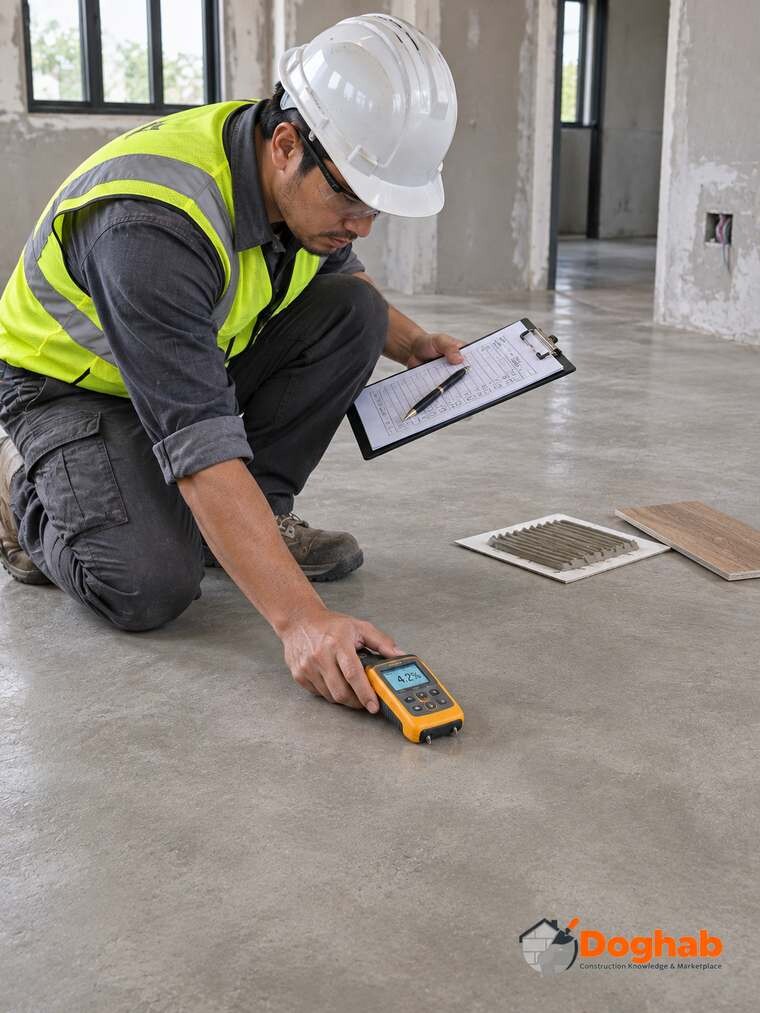
This distinction matters especially for interior slabs.
A slab can complete its required curing period and still contain too much moisture for a flooring adhesive, coating, hardwood floor, or another moisture-sensitive system.
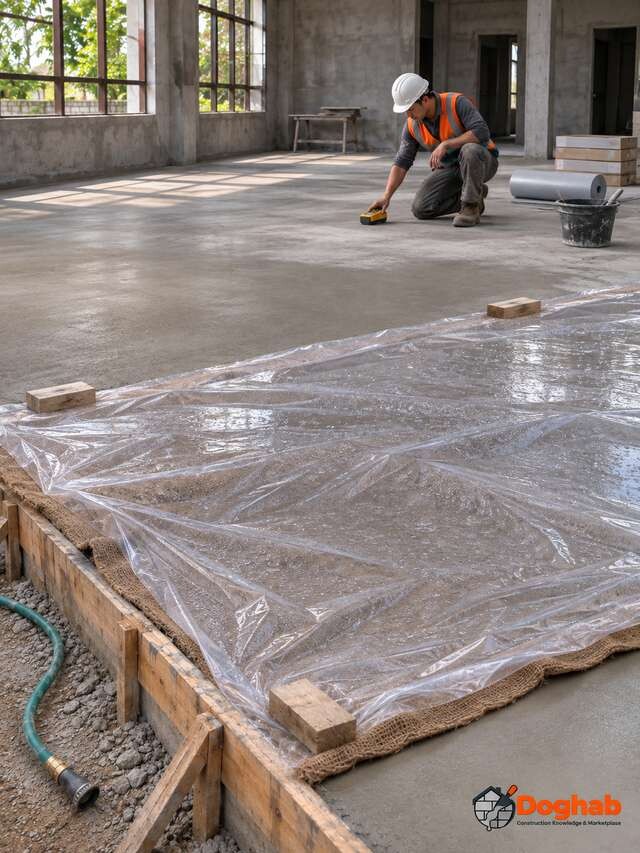
The practical sequence is:
Cure correctly → allow appropriate drying → test moisture when the final floor system requires it
Skipping curing simply to make the slab appear dry sooner is not a reliable way to prepare concrete for flooring.
Initial Curing and Final Curing
Concrete curing does not necessarily begin only after all finishing operations are complete.
ACI SPEC-308.1-23 distinguishes between initial curing and final curing.
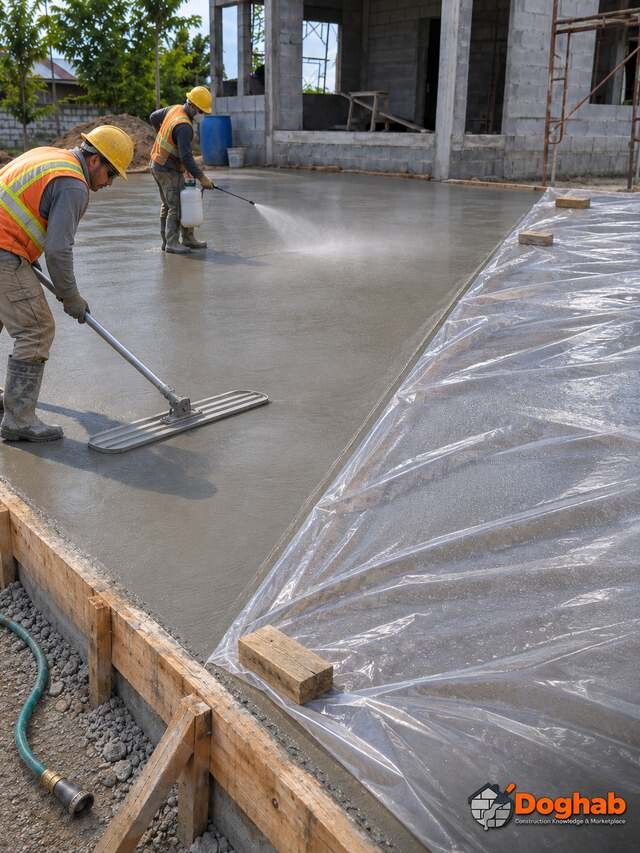
Initial Curing
Initial curing occurs between placement and final finishing.
Its purpose is to reduce excessive loss of water from the concrete surface while the material is still being placed and finished.
This becomes especially important when evaporation is high.
Final Curing
Final curing begins after final finishing and continues until the applicable curing termination requirement has been satisfied.
Its purpose includes limiting water loss and controlling concrete temperature.
The distinction matters because a surface can begin drying too rapidly before finishing is complete.
A curing plan therefore needs to exist before the truck arrives.
Evaporation Reducers Are Not Final Curing
Evaporation reducers can temporarily slow moisture loss from fresh concrete during placement and finishing.
They can be useful when drying conditions become severe before a final curing system can be installed.
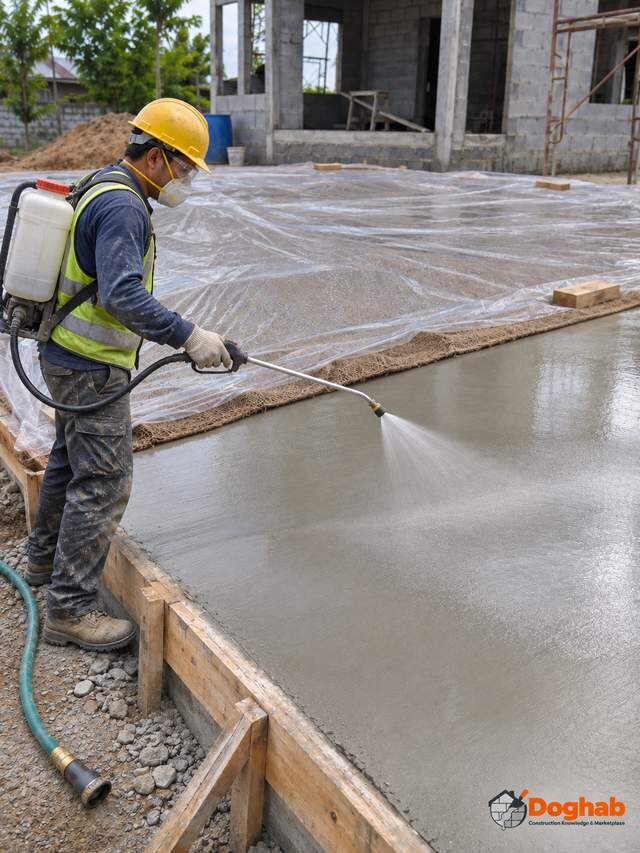
They are not the same as membrane-forming curing compounds.
An evaporation reducer helps protect fresh concrete during the working period.
A curing compound is intended to limit moisture loss during the subsequent curing period.
Using an evaporation reducer does not eliminate the need for final curing.
Main Concrete Curing Methods
External curing methods generally fall into two groups: moist curing supplies or maintains water at the surface through ponding, continuous sprinkling, or wet coverings; moisture-retention curing limits evaporation with impervious sheets or membrane-forming compounds. Both depend on continuous protection for the specified period. Some placements also need temperature protection, and no single method is appropriate for every job.
1. Ponding
Ponding keeps a horizontal concrete surface continuously covered with water.
Temporary dikes or berms retain water over the slab.
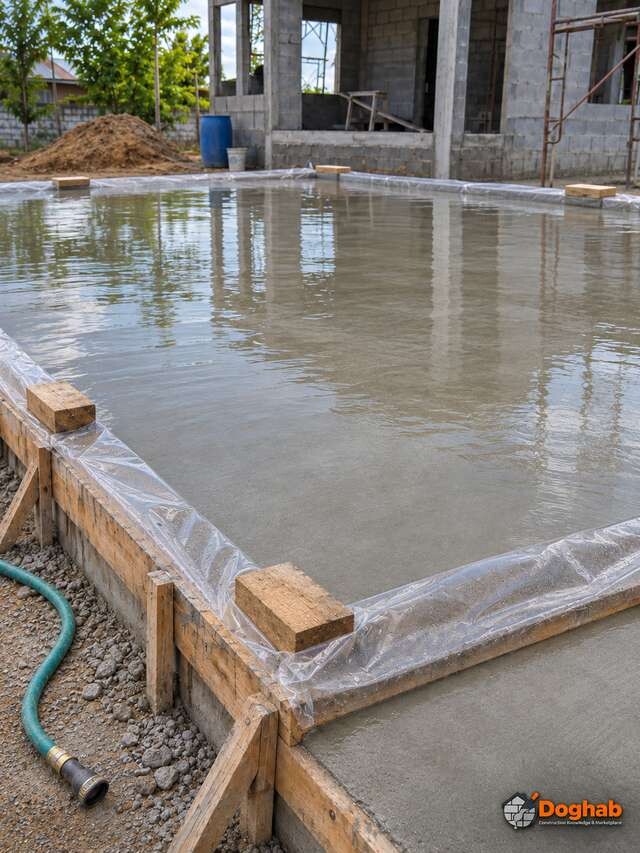
When practical, ponding can provide highly effective moist curing because the concrete remains continuously wet.
Where Ponding Fits
Ponding is most practical on relatively level horizontal surfaces where water can be contained safely.
It is usually less practical for:
- sloped concrete;
- vertical surfaces;
- many residential projects;
- areas where leakage would cause damage;
- decorative surfaces where appearance is critical.
Water and concrete temperatures also need consideration so the curing procedure does not create damaging temperature gradients.
2. Sprinkling and Continuous Water Curing
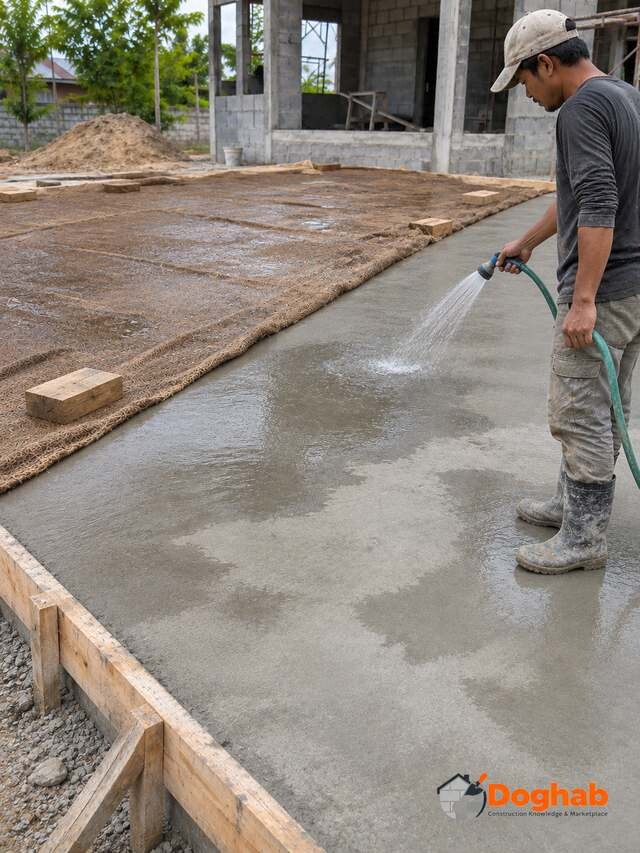
Concrete can be kept wet using sprinklers, soaker hoses, fogging equipment, or another controlled water system.
The key requirement is continuity.
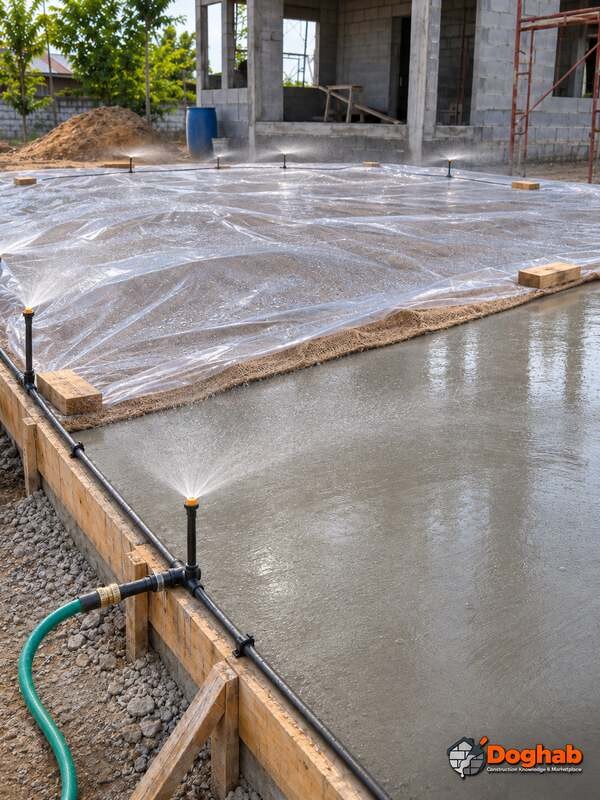
Spraying a slab occasionally and allowing it to dry completely between applications is not equivalent to continuous moist curing.
If water curing is selected, the method should maintain the required moisture conditions throughout the applicable period.
Runoff also needs to be managed so it does not:
- erode surrounding soil;
- damage landscaping;
- stain adjacent materials;
- enter unwanted areas.
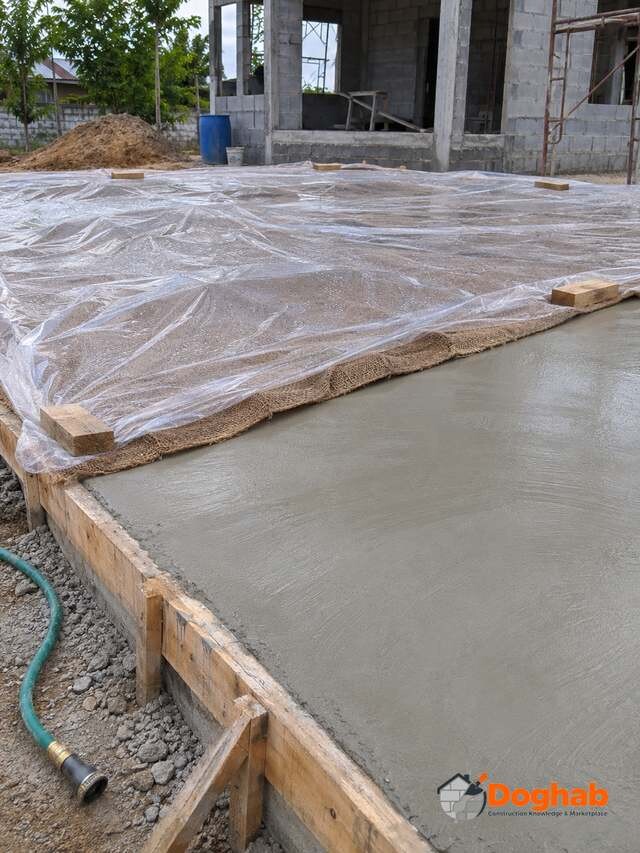
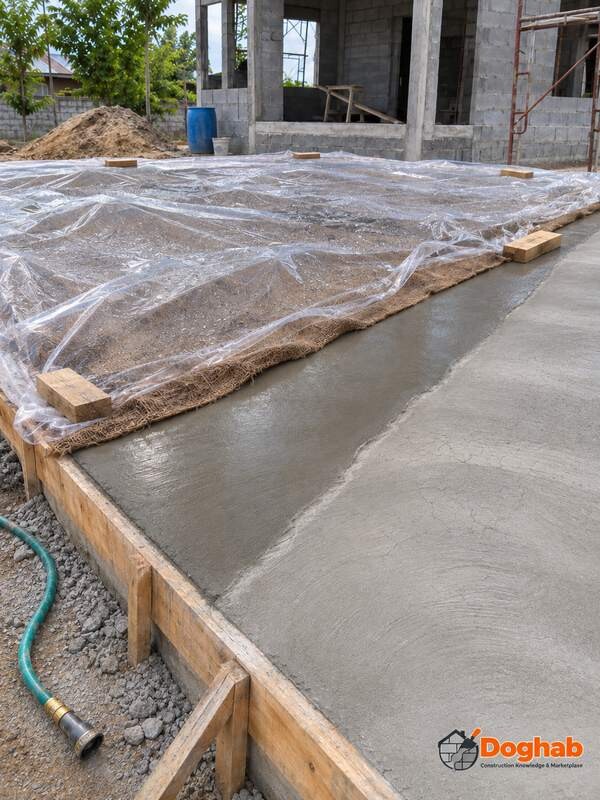
3. Wet Coverings
Absorbent coverings can be saturated and placed over concrete to maintain moisture.
Suitable materials may include curing blankets or burlap intended for concrete curing.
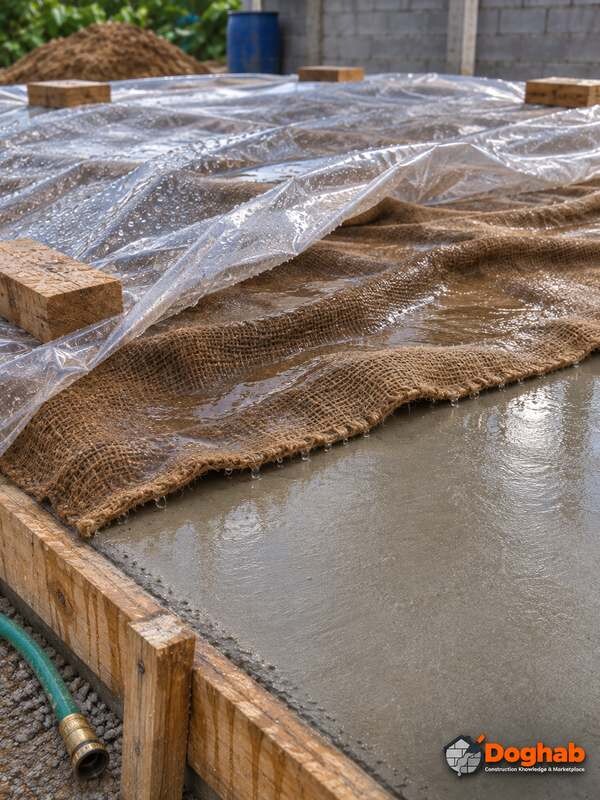
The covering should remain continuously wet.
A dry absorbent material can pull moisture away from the concrete rather than help cure it.
Combining a wet absorbent layer with an impervious outer sheet can reduce evaporation and make the moisture level easier to maintain.
Wet-cover curing works well in many situations, but it requires monitoring.
4. Plastic Sheets and Other Impervious Covers
Approved impervious sheet materials cure concrete by reducing moisture loss.
They generally retain water already present in the concrete rather than continuously adding new water.
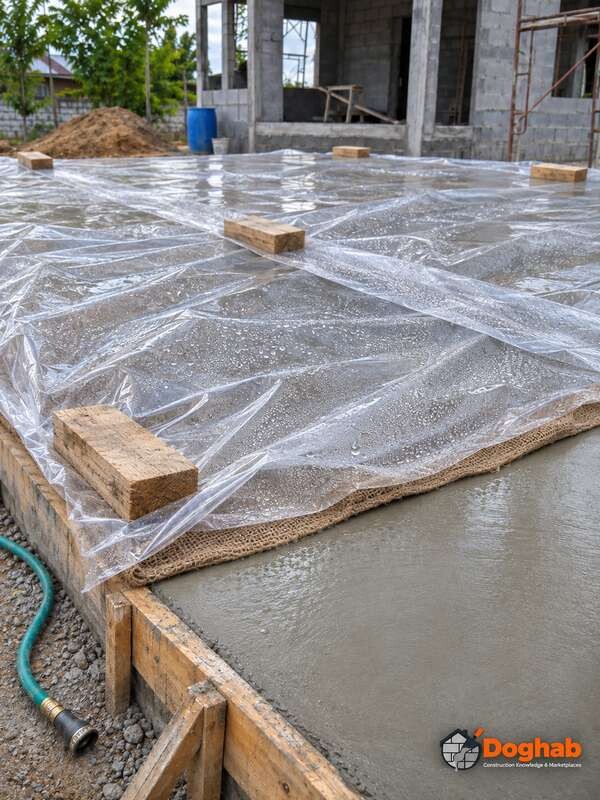
For the system to work properly:
- sheets need adequate overlap;
- edges need to remain secured;
- wind should not expose portions of the surface;
- the covering needs to remain continuous for the required period.
Appearance Can Be Affected
Sheet curing can create visible color variation or mottling where the sheet contacts the surface unevenly.
That may be acceptable for concealed or utilitarian concrete but undesirable on decorative work.
For exposed architectural concrete, curing method and appearance should be considered together before placement.
5. Liquid Membrane-Forming Curing Compounds
Curing compounds are widely used for slabs, pavements, and other concrete where continuous wet curing would be impractical.
The liquid is applied to the concrete surface and forms a membrane that limits moisture loss.
ASTM C309-25 covers liquid membrane-forming compounds used to limit water loss during early hardening. Other product requirements, including some cure-and-seal properties, may fall under specifications such as ASTM C1315.
Application Coverage Matters
A curing compound only works as intended if it creates the required membrane.
Problems can result from:
- missed areas;
- insufficient application;
- uneven coverage;
- damage after application;
- using an unsuitable product.
Follow the project specification and manufacturer application rate rather than judging coverage only by how wet or shiny the surface looks.
Timing Matters
ACI SPEC-308.1-23 requires membrane-forming curing compound to be applied after final finishing, after the surface-water sheen has disappeared and bleeding has ceased.
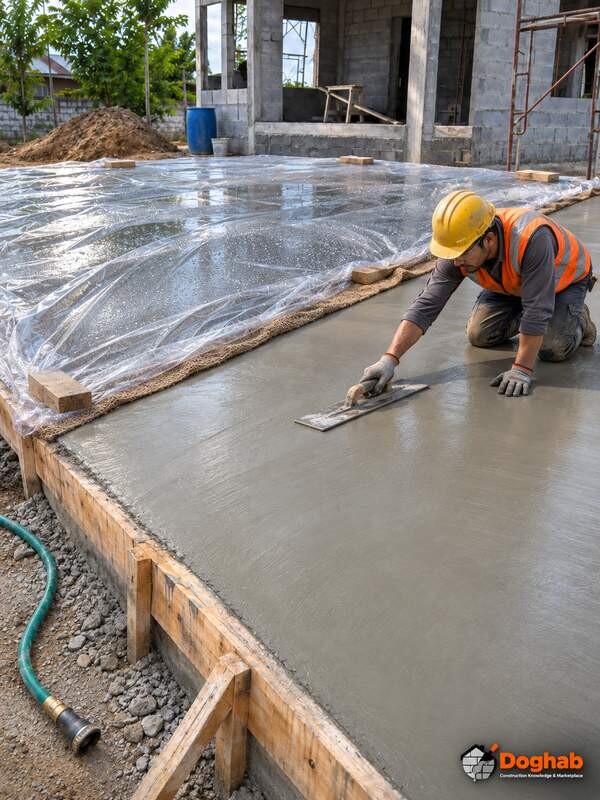
Applying compound while significant bleed water remains can interfere with the surface.
Waiting too long can allow unnecessary moisture loss.
Check Product Safety Requirements
Curing compounds have product-specific requirements for handling, ventilation, PPE, storage, and sometimes flammability.
Review the current Safety Data Sheet and manufacturer instructions before use, particularly on enclosed projects.
6. Leaving Forms in Place
Formwork can help limit moisture loss from formed concrete surfaces while it remains installed.
That does not automatically complete the curing requirement.
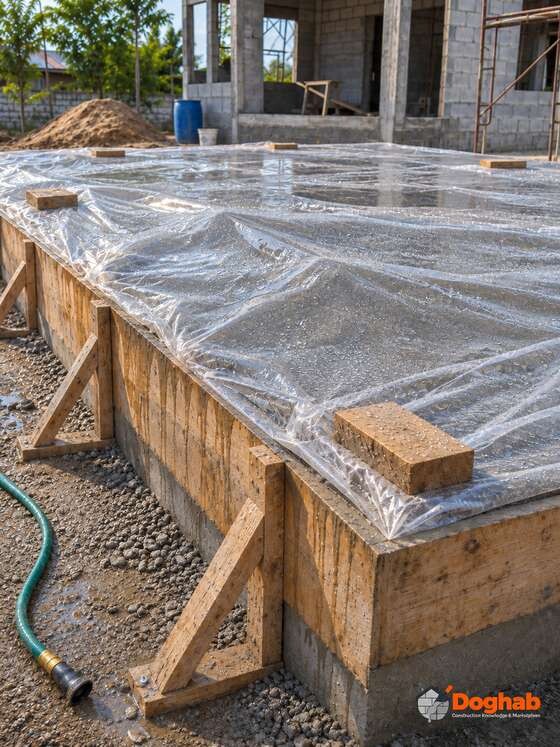
Exposed top surfaces still need appropriate curing.
After forms are removed, newly exposed concrete may require another approved method for the remainder of the curing period.
Forms should therefore be considered part of the curing strategy rather than proof that no separate curing plan is needed.
Choosing a Curing Method
| Project condition | Methods that may be considered | Main issue to verify |
|---|---|---|
| Exterior slab or driveway | Curing compound, wet covering, impervious sheet, or continuous water curing | Weather, finish, and project requirement |
| Decorative concrete | Compatible compound or controlled wet/sheet curing | Color and appearance |
| Interior hard-troweled floor | Method compatible with the final floor system | Adhesion and later surface preparation |
| Foundation wall | Forms plus additional curing where required after stripping | Exposed surfaces |
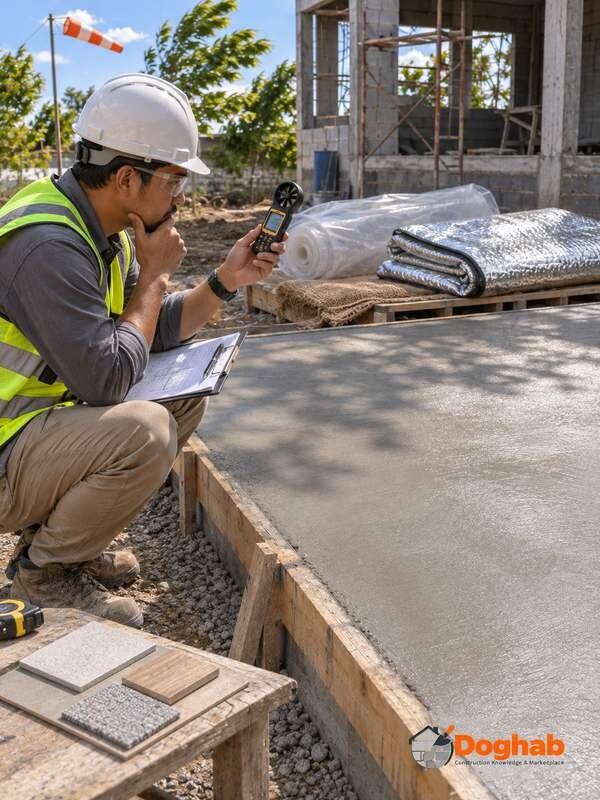
| Hot or windy placement | Initial evaporation protection plus prompt final curing | Rapid moisture loss |
| Cold-weather placement | Moisture retention plus thermal protection | Early freezing and concrete temperature |
| Pervious concrete | System-specific curing procedure | Rapid moisture loss from the open structure |
Project specifications and product requirements take precedence over generic selection advice.
When Should Concrete Curing Start?
The practical answer is:
As soon as the concrete condition and selected curing method require it.
That does not mean covering concrete immediately after it leaves the truck.
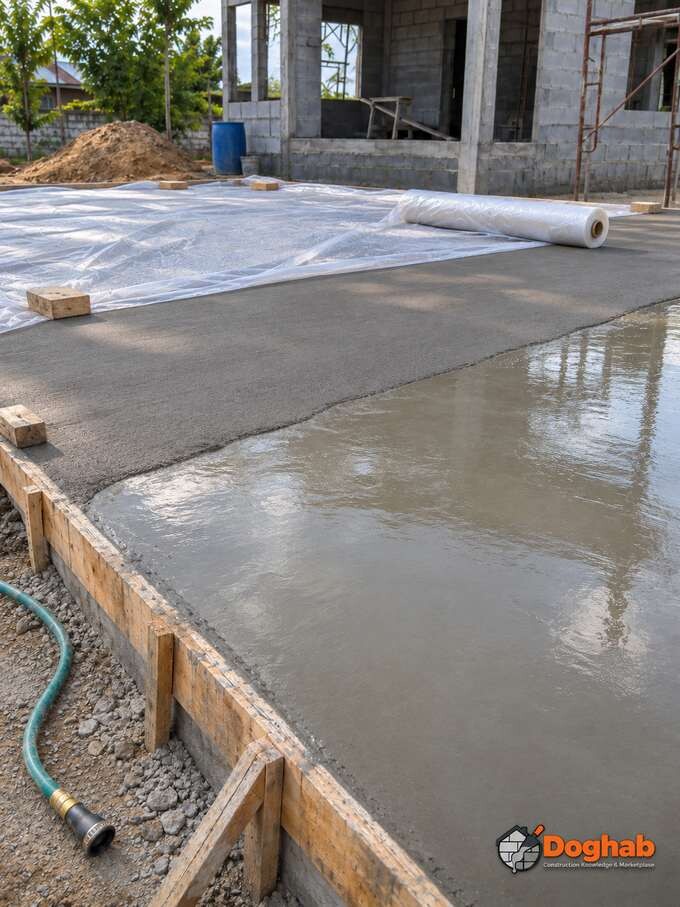
Placement, bleeding, finishing, weather, and curing method all affect timing.
During Placement and Finishing
When evaporation becomes high, initial protection may be needed while finishing is still underway.
Depending on the project, controls can include:
- fogging;
- wind protection;
- shading;
- evaporation reducers.
These measures are intended to prevent excessive early surface drying without damaging the fresh concrete.
After Final Finishing
Final curing should begin promptly when finishing is complete and the chosen curing method can be applied without damaging the surface.
The curing method should already be selected and available on site.
How Long Should Concrete Be Cured?
There is no universal curing duration that applies automatically to every project.
The project specification or approved curing termination criterion controls.
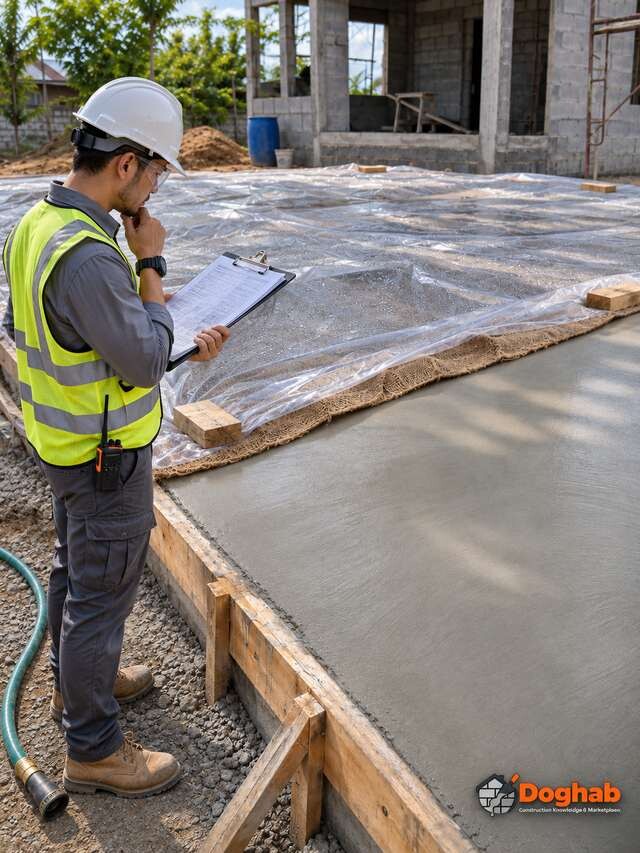
ACI SPEC-308.1-23 is a Reference Specification. It applies to a project when incorporated into the Contract Documents.
Under that Specification, one default termination method is a minimum curing duration of 7 days, unless another duration is specified and subject to its applicable temperature requirements.
The Specification also includes strength-based and in-place-test approaches for terminating curing when those methods apply.
This distinction is important:
Seven days is an ACI specification default under defined conditions. It is not a universal rule that overrides every project specification.
Concrete mixture, temperature, supplementary cementitious materials, exposure, required performance, and project documents can affect curing requirements.
Curing Time Is Not the Same as Concrete Strength
Elapsed time alone does not establish concrete strength.
Hardening describes the concrete becoming more rigid as it sets and gains strength. Curing is the deliberate control of moisture and temperature during that development. A surface that feels hard is not proof that the required curing period has ended.
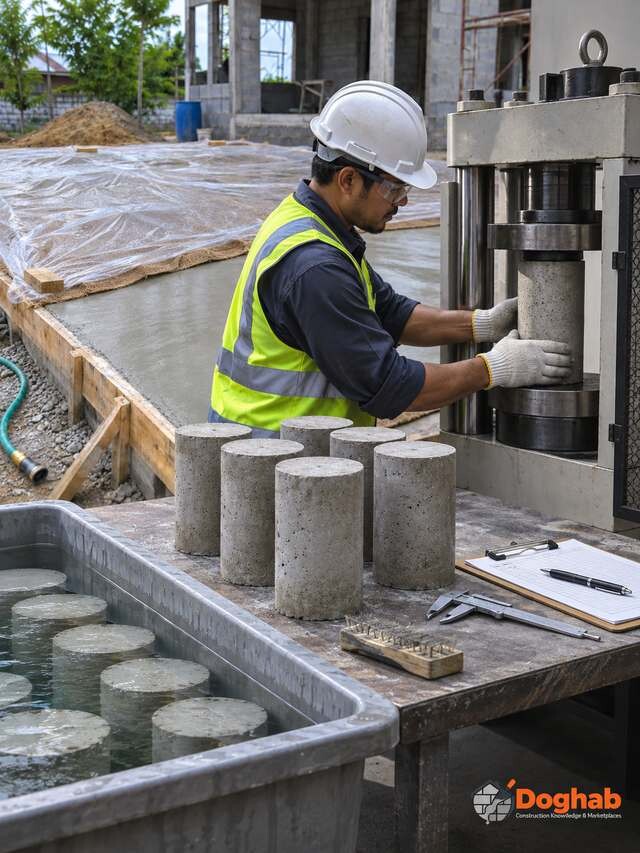
Concrete develops properties at different rates depending on factors such as:
- mixture proportions;
- cementitious materials;
- concrete temperature;
- curing temperature;
- moisture availability;
- use of accelerators or retarders.
Cool concrete generally develops strength more slowly.
Warmer concrete can develop early strength more rapidly, but excessively high early concrete temperatures can create other performance concerns.
Two slabs that are both seven days old therefore do not necessarily have the same strength.
Curing Duration Is Not the Same as Return to Service
Several questions are frequently treated as though they have one answer:
- How long should curing continue?
- When can someone walk on the slab?
- When can forms be removed?
- When can a car use a driveway?
- When can flooring be installed?
These decisions involve different criteria.
Ending a deliberate curing period does not automatically mean the concrete is ready for every load.
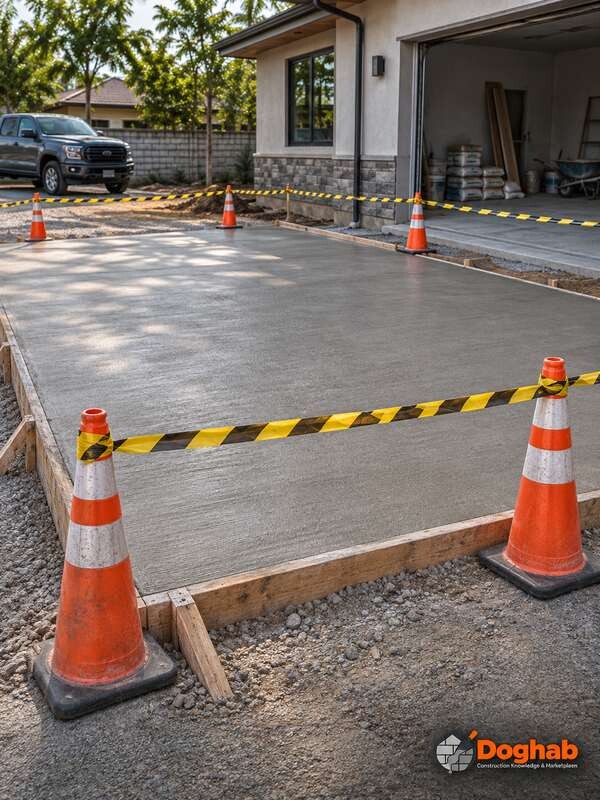
Vehicle access should depend on adequate strength and project requirements.
Floor installation may instead depend on slab moisture testing and the flooring-system requirements.
Concrete Curing in Hot Weather
Hot-weather concreting is not defined by one air-temperature number.
Conditions that can impair concrete include combinations of:
- high ambient temperature;
- high concrete temperature;
- low relative humidity;
- high wind speed.
Solar exposure can further worsen field conditions.
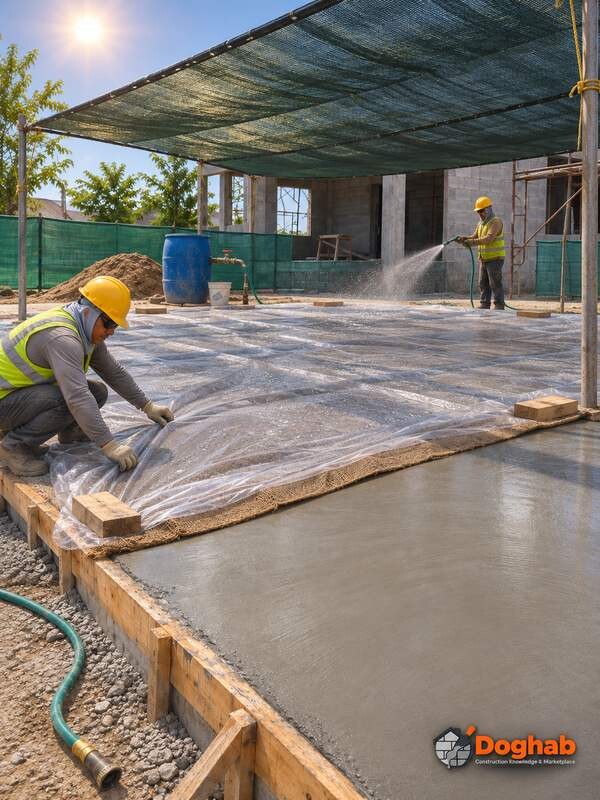
A warm but very dry and windy day can sometimes create a more severe evaporation problem than a hotter but calm and humid day.
Hot-Weather Risks
Potential problems include:
- rapid surface evaporation;
- plastic-shrinkage cracking;
- accelerated setting;
- reduced finishing time;
- surface crusting;
- high concrete temperature;
- thermal stresses.
Plan Before Placement
Depending on conditions, a hot-weather plan can include:
- placing during a more favorable part of the day;
- coordinating concrete temperature with the producer;
- providing shade;
- using windbreaks;
- ensuring sufficient labor and equipment are ready;
- fogging where appropriate;
- using an evaporation reducer;
- beginning final curing promptly.
The goal is controlled moisture and temperature management, not simply adding extra water to the concrete.
Wind and Humidity Matter
Air temperature is only one part of the evaporation problem.
The rate of moisture loss from fresh concrete is influenced by:
- concrete temperature;
- air temperature;
- relative humidity;
- wind speed.
Wind and concrete temperature can be particularly influential.
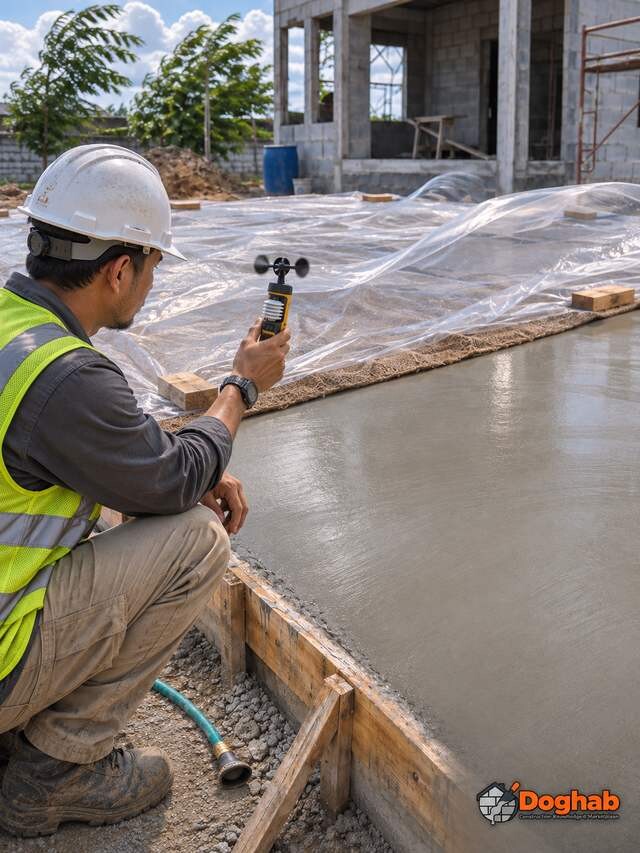
That means plastic-shrinkage risk is not limited to midsummer.
Cooler, dry, windy weather can also create rapid surface moisture loss.
Curing Concrete in Cold Weather
Cold-weather curing requires both moisture management and temperature protection.
For purposes of ACI SPEC-308.1-23, cold weather exists when the air temperature has fallen to, or is expected to fall below, 40°F (5°C) during the protection period.
That definition belongs to the ACI curing Specification and its protection provisions. It should not be treated as an isolated universal rule for every concrete decision.
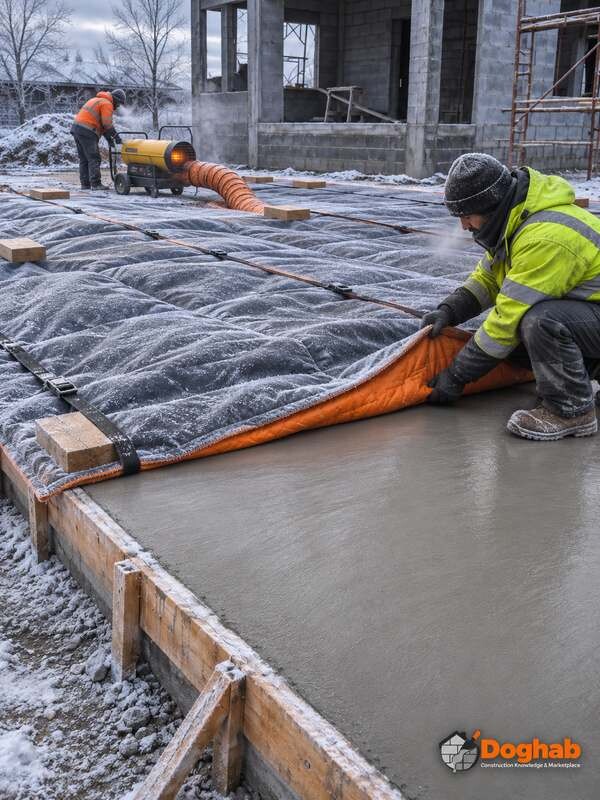
Protect Concrete From Early Freezing
Concrete that freezes before it has developed adequate early strength can be permanently damaged.
Depending on the project and conditions, protection can involve:
- insulated blankets;
- heated enclosures;
- protected forms;
- controlled concrete temperature;
- temperature monitoring;
- extended protection.
The required system depends on the weather, concrete mixture, member size, and project requirements.
Avoid Abrupt Cooling
Protection also needs to be removed appropriately.
Suddenly exposing warm concrete to very cold air can create large temperature differences between the surface and interior.
Cold-weather planning therefore includes the removal of thermal protection, not just its installation.
Water Curing May Not Be Practical
Water-added curing methods can create problems where water may freeze.
Cold-weather curing needs to coordinate moisture retention with thermal protection.
An impervious cover, insulated system, forms, or another approved method may be more practical.
What About Rain?
Rain should not be treated as a curing system.
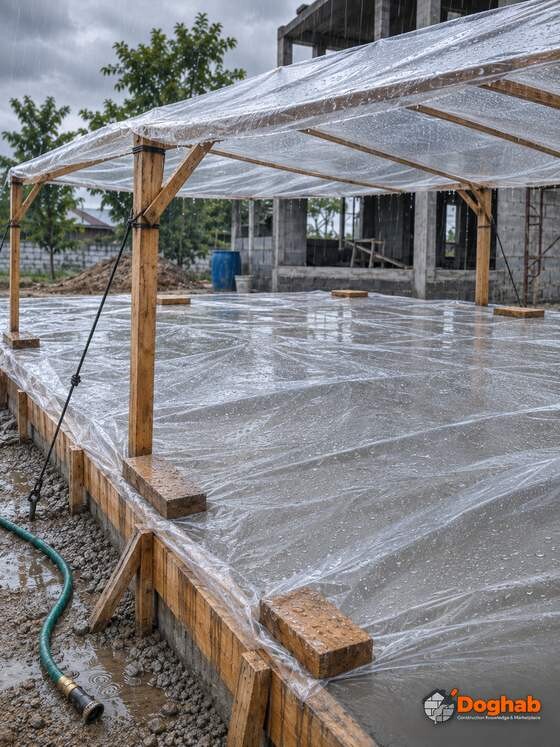
Rainfall on concrete that has not hardened sufficiently can:
- disturb the surface;
- interfere with finishing;
- wash cement paste;
- affect texture;
- damage decorative treatments.
After the concrete has hardened enough that rainfall no longer damages the surface, additional moisture is not inherently harmful to curing.
The problem is relying on unpredictable weather rather than an intentional curing plan.
If rain is forecast, suitable protective materials should be available before placement begins.
Curing Driveways, Patios, and Sidewalks
Exterior residential flatwork exposes a relatively large surface area to the environment.
The surface can therefore lose moisture rapidly under unfavorable conditions.
Depending on the project, suitable methods can include:
- membrane-forming curing compound;
- wet coverings;
- impervious sheets;
- controlled continuous water curing.
The choice should also consider:
- surface appearance;
- planned sealers;
- weather;
- decorative treatments;
- later coatings;
- return-to-service requirements.
Occasionally spraying the slab with a garden hose is not equivalent to controlled continuous moist curing.
Curing Interior Concrete Floors
Interior slabs still require curing.
A hard-troweled floor needs adequate curing to develop properties such as surface hardness, wear resistance, density, and general surface quality.
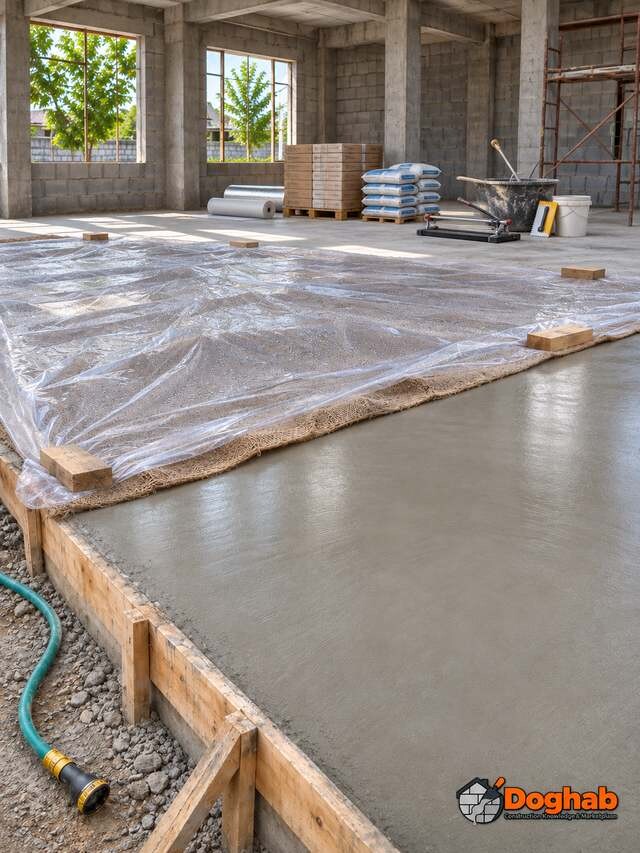
Interior floors also create an additional planning issue: what will eventually be installed on the concrete.
Possible later materials include:
- resilient flooring;
- hardwood;
- carpet;
- epoxy;
- coatings;
- moisture-sensitive adhesives.
The curing method needs to be coordinated with those later systems.
Curing Compounds and Future Flooring
A membrane-forming curing compound can remain on or near the concrete surface.
Some products can interfere with the adhesion of:
- flooring adhesives;
- coatings;
- toppings;
- waterproofing;
- other bonded systems.
Before selecting a curing compound for a slab that will receive another material, determine:
- what will eventually be bonded to the concrete;
- whether the products are compatible;
- whether the curing membrane must be removed;
- which surface-preparation method will be required.
This is another reason curing and drying should not be treated as the same issue.
Decorative Concrete Needs Additional Planning
Decorative concrete adds appearance requirements to the curing decision.
Plastic sheets, wet coverings, curing compounds, and differences in moisture exposure can affect color uniformity.
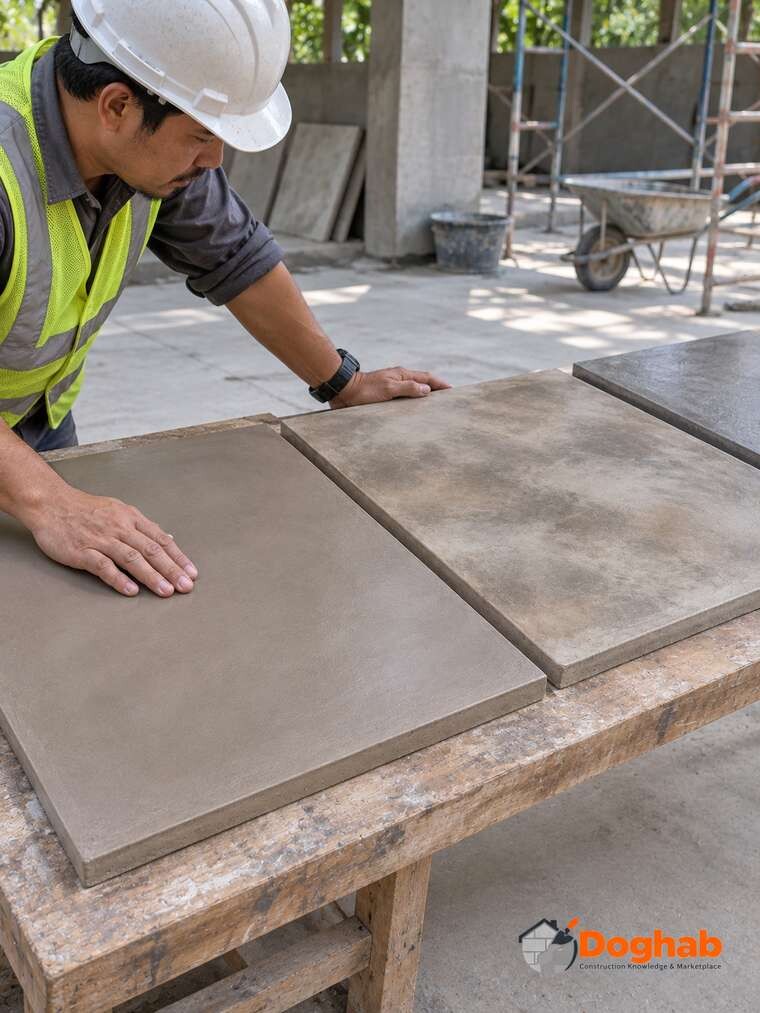
For exposed architectural or decorative concrete, determine in advance whether:
- sheets can create mottling;
- the curing compound may affect color;
- the planned sealer is compatible;
- the decorative-system manufacturer specifies a curing procedure.
Appearance should be coordinated with curing rather than used as a reason to skip it.
Curing Compound, Cure-and-Seal, and Sealer Are Not the Same
These terms are often used loosely, but they do not automatically describe interchangeable products.
Evaporation reducer
Temporary protection used during the fresh-concrete finishing period to slow evaporation.
Curing compound
A membrane-forming material primarily intended to reduce water loss during curing.
Cure-and-seal product
A product designed to provide curing and a later surface-film function when it meets the applicable product requirements.
Concrete sealer
A broader category of products intended primarily to alter the exposure or maintenance characteristics of hardened concrete.
A sealer intended only for hardened concrete should not automatically be used as a curing compound.
Check the actual product specification.
Common Concrete Curing Mistakes
Starting Too Late
Excessive moisture loss can begin before final finishing is complete.
Use initial protection when environmental conditions require it.
Stopping Because the Concrete Looks Hard
Surface appearance does not prove that the curing requirement has been satisfied.
Follow the specified curing termination criterion.
Intermittent Watering
Repeatedly wetting a slab and allowing it to dry completely is not equivalent to continuous moist curing.
Letting Wet Coverings Dry
A curing blanket or burlap only provides moist curing when it remains adequately wet.
Applying Curing Compound Unevenly
Thin areas and missed spots can allow uneven moisture loss.
Apply the material at the specified rate and coverage.
Applying Compound Over Active Bleed Water
Membrane-forming curing compound should not simply be applied while significant bleeding or surface-water sheen remains.
Correct timing matters.
Treating Evaporation Reducer as Final Curing
Evaporation reducer provides temporary protection during finishing.
It does not replace final curing.
Ignoring Wind
Wind, humidity, concrete temperature, and air temperature all influence early moisture loss.
Removing Cold-Weather Protection Abruptly
Rapid cooling can produce undesirable temperature gradients.
Follow the cold-weather protection plan when removing insulation or enclosures.
Ignoring Future Flooring or Coatings
A convenient curing product can create additional surface-preparation work if it is incompatible with the material that will later be bonded to the slab.
Possible Signs of Inadequate Curing
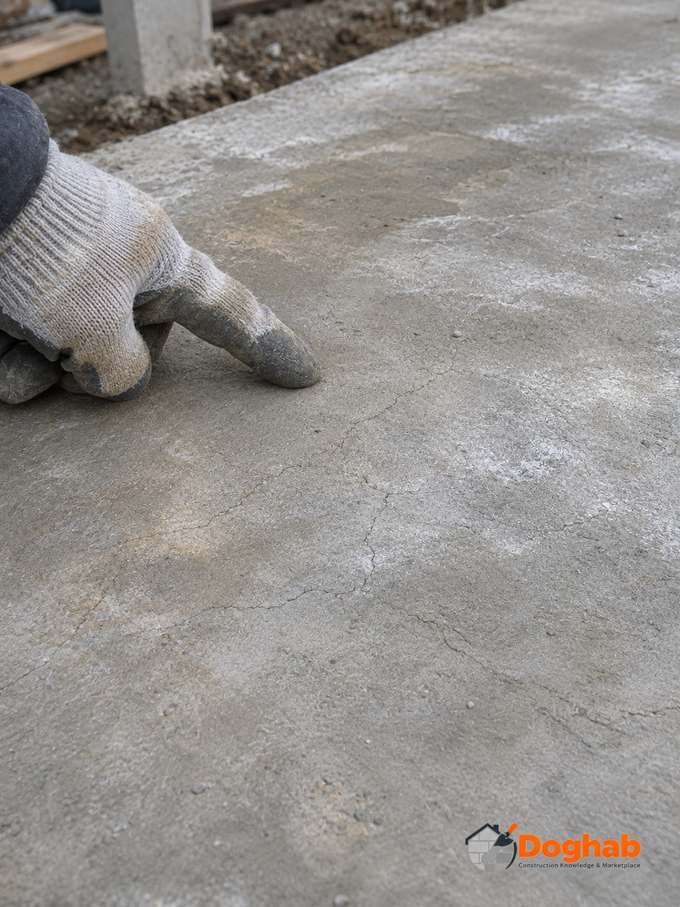
There is no single visual symptom that proves a concrete surface was improperly cured.
Several observations can justify investigation, but each can have more than one cause.
| Observation | Curing may contribute through | Other possible factors |
|---|---|---|
| Fine early-age cracks | Rapid moisture loss | Mixture, restraint, finishing, weather |
| Dusty or weak surface | Poor near-surface curing | Excess water, finishing, carbonation, mixture |
| Scaling | Reduced surface durability | Air system, deicers, finishing, freeze-thaw exposure |
| Color variation | Uneven curing conditions | Materials, finishing, moisture, sealer |
| Low early strength | Poor moisture or temperature conditions | Mixture, batching, testing |
| Curling or warping | Moisture and temperature gradients | Slab geometry, drying, support |
These symptoms should not be diagnosed from appearance alone.
The guide Concrete Cracks: Types, Causes, and When to Get Help covers concrete distress and crack diagnosis separately.
Questions to Ask a Contractor About Curing
A curing plan should exist before placement.
Ask:
- Which curing method will be used?
- When will initial protection begin if evaporation becomes severe?
- When will final curing begin?
- What determines when curing stops?
- Who will monitor wet coverings or curing membranes?
- How will the plan change if weather changes?
- What cold-weather protection is available?
- Is the curing product compatible with later flooring or coatings?
- Could the selected method affect decorative appearance?
- How will traffic be kept off the curing system?
A contractor who can describe placement and finishing in detail but cannot explain the curing plan has left an important part of the project unresolved.
For a checkable record, note the selected method, when final curing started, who monitored the covering or membrane, any interruptions or repairs, and the criterion used to end curing. This is a documentation aid, not a substitute for the project specification.
Concrete Curing Checklist
Before placement:
During placement and finishing:
After finishing:
Frequently Asked Questions
What Is Concrete Curing?
Concrete curing is deliberate moisture and temperature management that allows cementitious hydration and development of the intended concrete properties to continue under suitable conditions.
When Should Concrete Curing Start?
Protection begins when conditions require it.
Initial evaporation-control measures may be necessary during placement and finishing. Final curing begins promptly after finishing when the selected method can be applied without damaging the surface.
How Long Should Concrete Cure?
The project requirement controls.
When ACI SPEC-308.1-23 applies and another curing duration has not been specified, its default duration method uses a minimum of seven days under the applicable temperature provisions.
Other projects can use different durations or strength-based termination criteria.
Does Concrete Reach Full Strength After Seven Days?
No.
Curing duration and strength development are different concepts.
Concrete can continue gaining strength after deliberate curing ends.
Is Concrete Fully Cured After 28 Days?
Not in the sense that all hydration suddenly stops.
Twenty-eight days is commonly used as a reference age for specified compressive-strength testing. It is not a universal endpoint for concrete hydration, drying, or every curing procedure.
Can I Walk on Concrete While It Is Curing?
Curing and loading are separate issues.
Pedestrian access should follow the project's return-to-service requirements without damaging or prematurely removing the curing system.
When Can I Drive on New Concrete?
Vehicle traffic should be based on adequate strength and project requirements rather than one universal number of days.
Is Water the Best Way to Cure Concrete?
Continuous water curing can be highly effective, but it is not always the most practical or compatible approach.
Wet coverings, impervious sheets, membrane-forming compounds, or another approved method may be more appropriate for a particular project.
Does Concrete Need Curing in Cold Weather?
Yes.
Cold-weather concrete still needs suitable curing conditions and can also require protection against early freezing and unsuitable concrete temperatures.
Does High Humidity Eliminate the Need for Curing?
Not automatically.
High humidity can reduce evaporation, but curing requirements still apply and conditions can change.
Is Rain Good for Concrete Curing?
Rain is not a controlled curing method.
Rain on very fresh concrete can damage the surface. Once the concrete is sufficiently hardened, moisture itself may help maintain wet conditions, but deliberate curing should not depend on rainfall.
Can Any Concrete Sealer Be Used as a Curing Compound?
No.
Use a product intended and specified for curing fresh concrete when membrane curing is required.
A sealer designed only for hardened concrete is not automatically an acceptable curing material.
Final Curing Decision Guide
A practical curing plan can be built around four questions.
1. How quickly can the concrete lose moisture?
Consider concrete temperature, air temperature, humidity, wind, and exposure.
2. Which curing method can actually be maintained?
Choose water curing, wet coverings, impervious sheets, a curing compound, or another approved method that can remain effective.
3. Does the concrete need temperature protection?
Hot and cold weather can change both the curing method and the required protection.
4. What will eventually be installed on the concrete?
Flooring, coatings, waterproofing, sealers, and decorative systems can influence the curing-material decision.
Curing is not simply a waiting period after concrete placement.
It is deliberate moisture and temperature management while the concrete develops the properties the project depends on.
A reliable curing plan starts before placement and continues until the applicable curing requirement has been satisfied.
Technical References
The principal technical sources used for this guide are the American Concrete Institute's ACI PRC-308-26 — Curing of Concrete—Guide, ACI SPEC-308.1-23 — External Curing of Cast-in-Place Concrete—Specification, and the National Ready Mixed Concrete Association's Concrete in Practice resources, particularly CIP 11, CIP 12, and CIP 27.
Additional technical review included ACI guidance for hot- and cold-weather concreting, concrete slabs receiving moisture-sensitive flooring, and FHWA research on curing and evaporation.
Project specifications, applicable codes, concrete-mixture requirements, product instructions, and qualified professional requirements take precedence for an actual construction project.
Technical review: October 8, 2026.