
BIM and AI Integration in Construction: How It Works

How BIM and AI Work Together in Construction
Building Information Modeling and artificial intelligence are often discussed as if they were competing technologies. In practice, they solve different parts of the same problem.
BIM organizes the digital information about a building or infrastructure asset. AI analyzes that information—and often combines it with schedules, cost data, site images, scans, sensor data, or documents—to identify patterns, make predictions, classify conditions, or automate narrowly defined tasks.
The simplest way to understand the relationship is as a loop:
Project data → BIM information environment → AI analysis → insight or prediction → professional decision → updated project information
That distinction matters. AI does not replace BIM, and BIM does not become “intelligent” simply because an AI tool is connected to it. Useful integration depends on structured information, reliable data exchange, a clearly defined construction problem, and human validation of the result. Recent systematic reviews consistently describe BIM as the information backbone and AI as the analytical or automation layer built around that information.
BIM Is the Information Layer; AI Is the Intelligence Layer
BIM is much more than a three-dimensional model.
The U.S. National BIM Standard describes BIM around the digital representation and exchange of information needed to support decisions throughout an asset's lifecycle. In practice, that can include geometry, object properties, specifications, quantities, schedules, asset information, coordination data, and links to other project records. NBIMS-US also emphasizes information exchange, BIM execution planning, BIM uses, and lifecycle information management rather than treating BIM as a single software product.
AI performs a different role. Machine-learning systems can find relationships in structured project data. Deep-learning models can interpret images, video, point clouds, or other high-dimensional data. Natural-language systems can help retrieve or classify information in project documents. Generative approaches can propose alternatives or generate data, while MLOps practices help teams manage deployed AI models over time.
The integration happens when those AI capabilities are connected to BIM information and to an actual project decision.
| Layer | Main role | Typical construction information |
|---|---|---|
| BIM | Organizes and relates project information | Geometry, elements, quantities, properties, schedule links, asset data |
| CDE and connected systems | Manage and exchange information | Documents, revisions, approvals, field records |
| Reality-capture and operational data | Describe what is happening outside the model | Photos, video, laser scans, sensors, equipment or building data |
| AI | Analyzes selected data | Detection, classification, prediction, prioritization, generation |
| Project team | Validates and acts on the result | Coordination, planning, design, inspection, maintenance decisions |
This is why a sophisticated AI model connected to poorly governed BIM data can still produce an unreliable workflow.
How a BIM–AI Workflow Actually Works
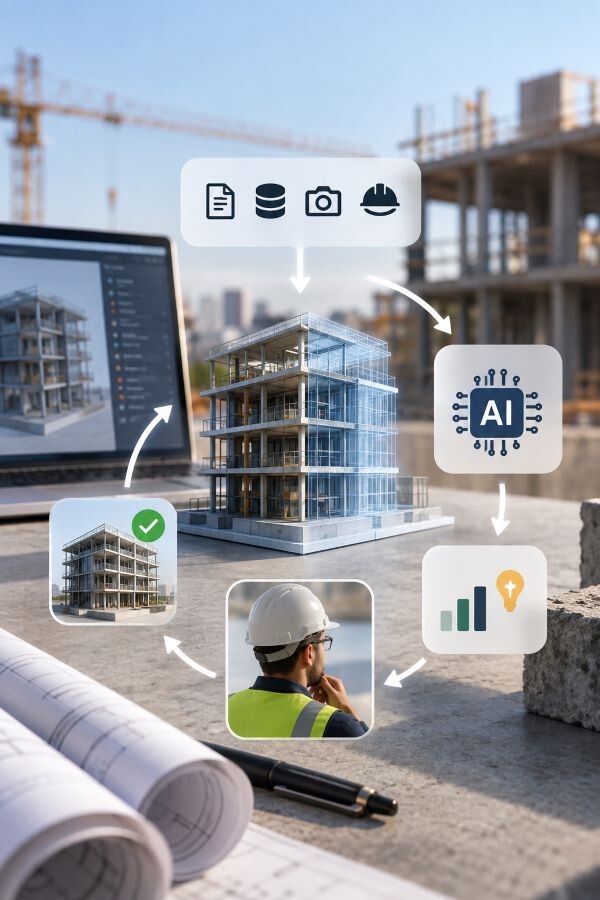
A production workflow usually begins with a construction problem, not with an AI model.
Suppose a contractor wants earlier warning that field progress is drifting away from the schedule. The team first needs an authoritative model and schedule relationship. Site observations then need to be captured consistently. Only after that can an AI system compare observed conditions with planned conditions and flag possible deviations.
The same logic applies to clash management, cost forecasting, condition assessment, energy analysis, and predictive maintenance.
| Stage | What happens | Why it matters |
|---|---|---|
| 1. Define the decision | Specify the task AI is meant to support | Prevents “AI for AI's sake” |
| 2. Establish the BIM information base | Identify the authoritative model, objects, properties, versions, and related data | Gives the system a dependable project context |
| 3. Connect additional data | Add schedules, costs, images, scans, sensors, documents, or field records when required | Many useful signals do not exist inside the BIM model itself |
| 4. Prepare and map the data | Clean, label, align, and relate information across systems | AI performance depends heavily on data quality and semantics |
| 5. Run the AI analysis | Detect, classify, predict, rank, or generate an output | Produces a decision-support result |
| 6. Validate and return the result | A professional reviews the result before it affects the project | Maintains accountability and allows the workflow to improve |
The key technical challenge is often Stage 4 rather than Stage 5. A 2026 systematic review of AI–BIM construction-management research found that data exchange remains fragmented and that moving information between BIM, spreadsheets, databases, IFC workflows, and AI environments can require substantial preprocessing or semantic reconstruction.
Where the Data Comes From
An AI-enabled BIM workflow rarely uses only the geometry visible in a model.
For design and coordination, relevant information may include object categories, systems, dimensions, spatial relationships, model issues, specifications, and revision history.
For construction management, BIM data may be combined with 4D schedule information, 5D cost information, procurement records, daily reports, or productivity data.
For progress monitoring and quality control, the system may also receive photographs, drone imagery, video, laser scans, or point clouds collected from the jobsite.
During operation, BIM or a digital-twin environment may be connected to sensors, maintenance records, equipment information, energy data, or other building-management systems.
This is one reason the phrase “AI inside BIM” can be misleading. In many practical systems, BIM provides context while the AI model operates across several connected data sources.
What AI Can Do With BIM Data
Different AI techniques are useful for different types of construction information.
Traditional machine learning is often suited to structured datasets where variables such as quantities, schedule information, costs, or asset characteristics can be represented consistently. These models can support classification, forecasting, or risk prediction.
Deep learning becomes particularly relevant when the input is visual or spatial. Computer-vision models can analyze jobsite photographs, video, scans, or point clouds and relate detected conditions to the BIM environment.
Natural-language processing can support document classification, information retrieval, specification analysis, or querying of project information, although integration with reliable project semantics is still an active research area.
Generative AI introduces another layer. It may help create design alternatives, synthesize data, assist information retrieval, or support communication around model information. However, generating plausible output is not the same as producing verified engineering information.
The 2025 systematic review supplied for this article found that deep learning, machine learning, digital twins, BIM modeling, and multidimensional BIM account for much of the recent research activity, while areas such as robust common-data-environment integration and production-scale MLOps remain less mature.
Clash Detection Shows the Difference Between Automation and Intelligence
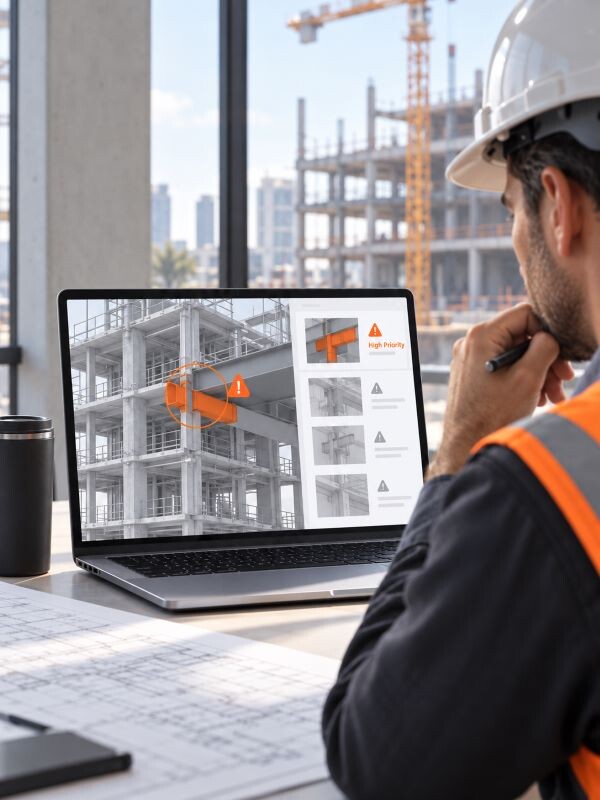
Clash detection is a useful example because BIM already automates part of the process.
Traditional coordination software can identify geometric conflicts between model elements. The difficult part is what happens next: Which clashes matter? Which are duplicates or low priority? Which discipline should address them first? Can a conflict be resolved without creating another problem?
AI research is increasingly focused on filtering and prioritizing detected clashes. But the evidence does not support the idea that autonomous clash resolution is already a mature construction workflow.
A 2026 review of AI in BIM clash management found that automated clash detection itself is operationally mature, while filtering, prioritization, resolution, and prevention still depend heavily on expert judgment. Research has progressed furthest in filtering; automated resolution and prevention remain less developed, and some systems described as autonomous have been evaluated mainly in simulated environments.
In other words, AI can reduce coordination noise without eliminating the coordinator.
AI-Assisted Construction Progress Monitoring
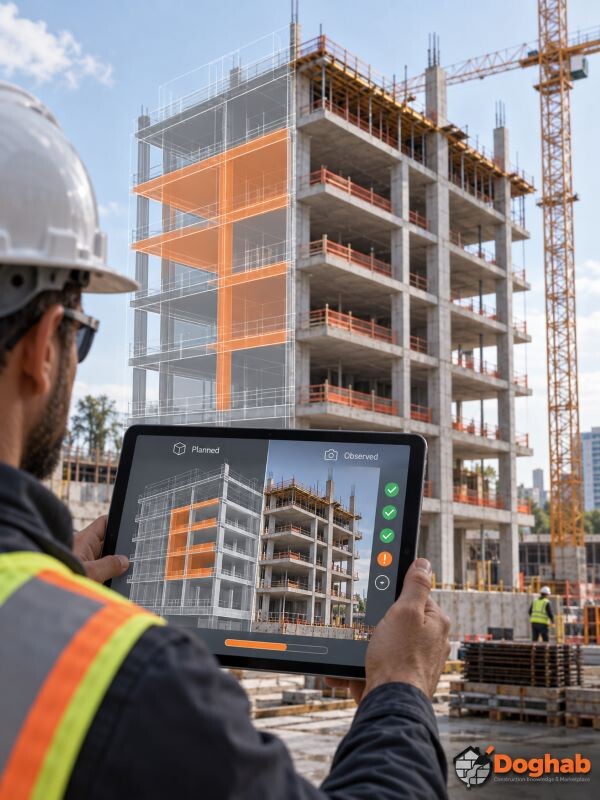
Progress monitoring provides a clearer example of a complete BIM–AI data loop.
The project begins with a BIM model linked to the construction schedule. Site conditions are then captured through photographs, video, laser scanning, or another reality-capture method.
Computer-vision or point-cloud processing techniques can identify constructed elements or classify visible conditions. The detected state can then be compared with the planned BIM and schedule information.
Instead of asking a project manager to manually inspect every possible difference, the system can highlight areas that may need attention.
The project team still determines whether the apparent deviation is real, whether the source data is current, and whether an intervention is required.
Research published in 2026 shows that Scan-to-BIM automation, condition assessment, and performance prediction are among the more active BIM–AI workflow areas, but it also finds that many published systems remain case studies or experimental demonstrations rather than broadly validated production benchmarks.
4D and 5D BIM Can Give AI a Time and Cost Context
A conventional BIM model explains what an asset is and how its components relate spatially.
Connecting BIM to a schedule adds the time dimension commonly described as 4D BIM. Connecting cost information creates the workflows commonly associated with 5D BIM.
Those relationships are valuable to AI because predictions can be placed in project context.
An AI system might analyze historical and current project information to identify patterns associated with schedule delay, estimate changes, resource constraints, or cost deviation. The result can then be linked back to affected activities or model elements rather than being presented as an isolated statistical prediction.
This does not mean that an AI forecast should become the project schedule or budget automatically. Construction projects contain contractual, logistical, design, labor, weather, procurement, and site-specific variables that may not be represented adequately in a training dataset.
A 2026 review of 47 studies on BIM–AI construction management concluded that the evidence is promising but uneven. Benchmark availability, dataset quality, reproducibility, and validation remain recurring limitations, making results difficult to generalize across different project environments.
Digital Twins Extend the BIM–AI Loop Into Operations
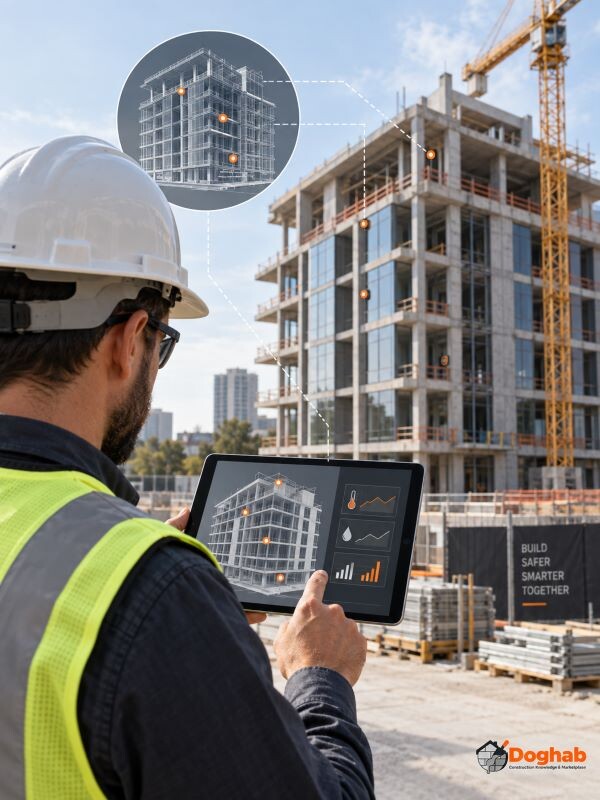
BIM becomes especially useful to AI when project information continues beyond design and construction.
A digital twin can connect a digital representation of an asset with changing information from the physical asset. Depending on the application, that information might include sensor readings, equipment states, environmental conditions, inspection results, or maintenance history.
AI can analyze those streams for patterns that would be difficult to detect manually. Potential applications include anomaly detection, equipment-condition analysis, energy-performance forecasting, and maintenance prioritization.
The important distinction is that BIM provides structured asset context, the operational systems provide changing observations, and AI analyzes those observations.
A digital twin is therefore not simply a BIM model with an AI interface. The value comes from maintaining meaningful connections between the asset, its information, and its current state. Recent BIM–AI research identifies digital twins as one of the stronger areas of integration, particularly when paired with deep-learning methods.
Why BIM–AI Integration Is Harder Than Connecting Two Software Tools
The main obstacles are often information-management problems.
Interoperability is one of them. Open formats such as IFC are important for exchanging BIM information, but exporting a model does not guarantee that every semantic relationship needed by an AI workflow survives the transfer. Some applications require additional parsing, mapping, enrichment, or reconstruction.
Data quality is another. Missing attributes, inconsistent classifications, duplicate objects, outdated versions, weak labeling, or inconsistent field data can undermine an AI model before training begins.
Validation is equally important. A model that performs well on one project may not perform equally well on another building type, contractor workflow, geography, camera setup, or modeling standard. The 2026 architecture-focused review of 113 studies found that benchmark-based evaluation and cross-validation remain less common than experimental and case-study validation.
Explainability and accountability also matter. Construction teams need to know what information influenced a recommendation, what assumptions are embedded in the model, and who is responsible for accepting or rejecting the result.
Finally, there is a workflow problem. If an AI output does not reach the person who can make a decision—or if it arrives outside the established BIM, coordination, issue-management, or approval process—it may add another dashboard without improving the project.
What a Production-Ready BIM–AI Setup Looks Like
A useful implementation begins with a narrow, measurable decision.
Instead of starting with a goal such as “add AI to BIM,” a team can start with something operational: reduce time spent reviewing low-value clashes, identify possible schedule deviations earlier, classify progress imagery, or prioritize assets for inspection.
The BIM and information-management process should then establish which data is authoritative, how it is structured, who controls revisions, and how information moves through the project's common data environment.
NBIMS-US provides a useful U.S. framework for thinking about these questions because its BIM guidance covers project BIM requirements, execution planning, BIM uses, information exchange, and lifecycle information rather than prescribing a single technology stack.
The AI component can then be evaluated against the existing process. A pilot should answer practical questions: Does it outperform the current baseline? How often are false positives created? What information is missing? Can the result be traced to source data? Does another project produce similar results?
If the model becomes operational, version control, monitoring, data lineage, access control, retraining rules, and model governance become part of the construction-technology workflow. This is where MLOps becomes more important than simply selecting a more sophisticated AI algorithm. The 2025 systematic review identifies governance, reproducibility, data lineage, shared datasets, and MLOps as important conditions for scaling BIM–AI systems beyond isolated demonstrations.
What AI Does Not Replace
AI does not remove the need for a BIM execution strategy, reliable model authorship, information requirements, coordination responsibilities, design review, or professional judgment.
It also does not determine whether a design complies with every applicable code simply because the relevant geometry exists in BIM.
An AI-generated recommendation can be useful evidence for a decision. It is not automatically an approved design change, contractual instruction, inspection result, engineering calculation, or code determination.
For U.S. projects, project requirements, applicable standards, contracts, local regulations, and the authority of responsible professionals still determine how information is approved and acted upon.
That human-in-the-loop approach is not merely a temporary limitation of today's AI. It is part of responsible information governance in a project where design, safety, cost, schedule, and contractual decisions can carry real consequences.
Where BIM and AI Are Heading
The next stage of BIM–AI development is likely to involve deeper connections between project semantics and AI systems rather than simply adding more AI features to modeling software.
Research is moving toward richer digital twins, semantic and graph-based representations, automated reality capture, generative systems, large language models, and better deployment pipelines.
But the current evidence also points in the opposite direction of the popular “fully autonomous construction project” narrative.
As AI becomes more capable, information governance, interoperability, validation, traceability, and professional oversight become more important—not less.
The most valuable BIM–AI systems will probably not be the ones that try to automate every construction decision. They will be the ones that take a clearly defined stream of project information, analyze it reliably, and deliver a useful signal to the right professional at the right point in the workflow.
The Bottom Line
BIM and AI work together when BIM provides a reliable digital context for the project and AI turns selected project data into classifications, predictions, priorities, or other decision-support outputs.
The practical architecture is straightforward:
reliable project information → AI analysis → validated insight → professional decision → updated project information.
What makes that architecture difficult is not the concept. It is creating trustworthy data connections, preserving meaning between systems, validating models outside a single demonstration project, and integrating the result into real construction responsibilities.
For contractors, builders, designers, and project managers, that is the most useful way to evaluate an “AI-powered BIM” claim: not by asking how advanced the AI sounds, but by asking what data it uses, what decision it supports, how its result is validated, and who remains responsible for acting on it.
Sources reviewed
This guide was researched against the 2025 Applied Sciences systematic review on AI–BIM integration, the 2026 Sustainability systematic review on BIM–AI construction-management performance, the 2026 workflow-based review of BIM–AI integration in architecture, current research on AI-assisted BIM clash management, and the U.S. National BIM Standard. Research was checked September 12, 2026.